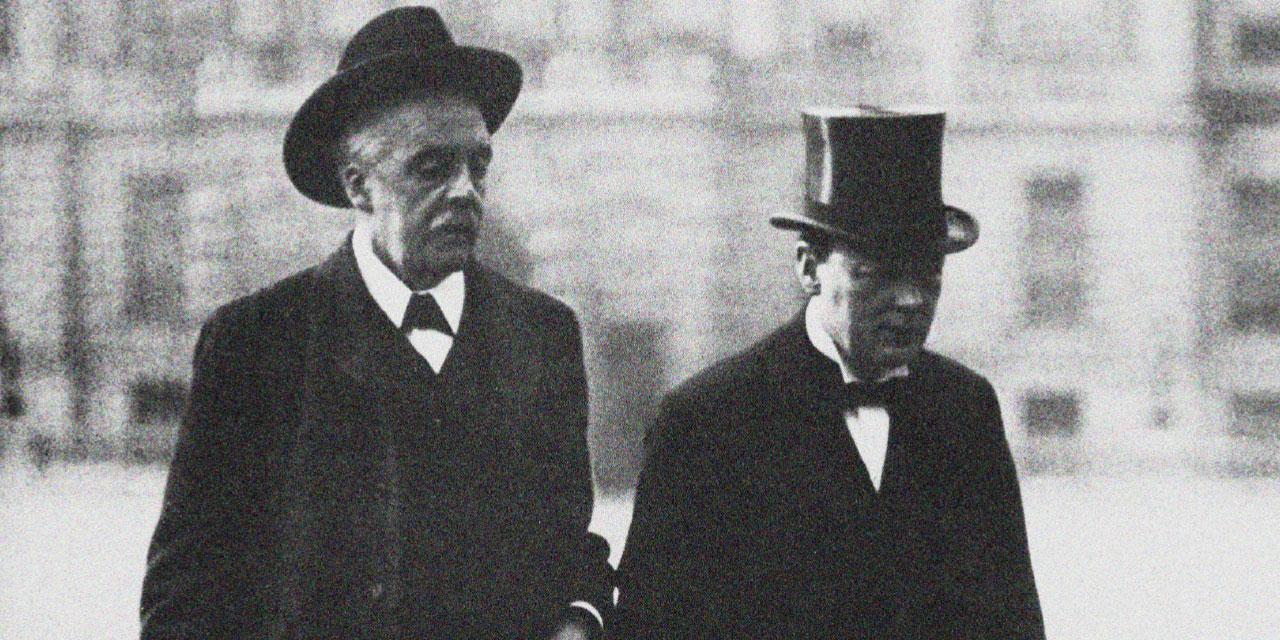
In 1921, Churchill confronted Arab pressure to scrap the Balfour Declaration by saying that even if it was within his power it wouldn’t be his wish. An Arab delegation appealed to Churchill to veto Jewish immigration to Palestine and abolish the idea of a national home for the Jews. Churchill boldly responded, “It is manifestly right that the Jews, who are scattered all over the world, should have a national centre and a national home where some of them may be reunited. And where else could that be but in this land of Palestine, with which for more than 3,000 years they have been intimately and profoundly associated? We think it will be good for the world, good for the Jews and good for the British Empire. But we also think it will be good for the Arabs who dwell in Palestine.”
He later remarked, “I am myself perfectly convinced that the cause of Zionism is one which carries with it much that is good for the whole world, and not only for the Jewish people.”
But in 1922, the Balfour Declaration was under immense threat from what should have been the most unlikely of places – Parliament. Incredibly, the House of Lords voted against the Declaration, declaring that the Palestine Mandate was unacceptable over concerns that it would provide a Jewish minority with powers over the Arab majority. It was a defining moment in Britain’s support for a Jewish homeland. In a powerful, commanding speech, Churchill addressed the Commons in defence of the Balfour Declaration. Described by some historians as one of Churchill’s greatest speeches he ever gave, this crucial speech led to a vote in favour of the Palestine policy, reversing the vote in the House of Lords. The principles of the mandate became known as the Churchill White Paper and was approved by the League of Nations on 22nd July 1922.
From Churchill’s 1922 White Paper, the Jewish population of Palestine grew from 80,000 to 380,000 between 1922 and 1936. While the Arab population also grew, the right of the Jews to immigrate to Palestine was firmly established. The White Paper also reassured the Arabs that the Balfour Declaration would deprive them of nothing, saying that the Jews had a place in their ancestral lands “as of right not of sufferance….For the fulfilment of this policy it is necessary that the Jewish community in Palestine should be able to increase its numbers by immigration.”
A witness to the miraculous
Churchill’s support for the Zionist dream was unwavering. In Parliament on July 1932, Churchill appealed to the House of Commons “to stand faithfully to the undertakings which have been given in the name of Britain and interpret in an honourable and earnest way the promise that Britain will do her best to fulfil her undertakings to the Zionists.” In the same debate, Churchill praised the restoration of the Jewish homeland and saw its benefits to both Jews and Arabs alike, whilst delivering a scathing attack on the Arab failure to previously do likewise.
“Anyone who has visited Palestine recently must have seen how parts of the desert have been converted into gardens, and how material improvement has been effected in every respect by the Arab population dwelling around,” he remarked approvingly. “On the sides of the hills there are enormous systems of terraces, and they are now the abode of an active cultivating population; whereas before, under centuries of Turkish and Arab rule, they had relapsed into a wilderness. There is no doubt whatever that in that country there is room for still further energy and development if capital and other forces be allowed to play their part. There is no doubt that there is room for a far larger number of people, and this far larger number of people will be able to lead far more decent and prosperous lives.”
Churchill continued to acclaim the agricultural, scientific and industrial development, including the water irrigation that was turning the land fertile and employing the Arab population.
“Was not this a good gift which would impress more than anything else on the Arab population that the Zionists were their friends and helpers, not their expellers and expropriators, and that the earth was a generous mother, that Palestine had before it a bright future, and that there was enough for all?
He added, “I am told that the Arabs would have done it themselves. Who is going to believe that? Left to themselves, the Arabs of Palestine would not in a thousand years have taken effective steps towards the irrigation and electrification of Palestine. They would have been quite content to dwell—a handful of philosophic people—in the wasted sun-scorched plains, letting the waters of the, Jordan continue to flow unbridled and unharnessed into the Dead Sea.”
It was frankly a pro-Israel speech that would have shuddered any anti-Semites in Parliament at the time. And in typical Churchill style, he fashioned a phrase in support of Jewish immigration that perfectly rebuts apartheid against Jews, by tapping into his Biblical knowledge once more. “Over the portals of the new Jerusalem,” he retorted, “you are going to inscribe the legend, ‘No Israelite need apply,’ then I hope the House will permit me to confine my attention exclusively to Irish matters.”
The struggle against British Foreign Policy
Throughout the 1920s, the British were confronted with coordinated Arab riots against Jews in Palestine, culminating in the Mufti’s Arab Revolt of 1936-39 as the Jewish refugee crisis continued to intensify.
On 11 November 1936 the Peel Commission arrived in the Holy Land to explore causes and solutions to the Arab unrest. On 25 November Chaim Weizmann testified before the Commission, saying, “Today almost six million Jews…are doomed to be pent up in places where they are not wanted, for whom the world is divided into places where they cannot live and places where they cannot enter.”
Churchill heeded Weizmann’s wisdom and on 24 March 1936, Churchill urged Parliament to allow as many Jews into Palestine as necessary. Heeding Churchill’s warning, on 7 July 1937 the Peel Commission published its report which recognised the threat posed to the Jews who were desperate to leave Europe and asserted that “restrictions on Jewish immigration will not solve the Palestine problem.”
The Commission also recommended partitioning Palestine into a Jewish and an Arab state as the only viable solution to the tensions between the Jews and the Arabs. Churchill opposed the idea. He warned, “The policy of Partition will not lead away from violence but into its very heart; will not end in peace, but in war.” He was right.
In 1939, a new White Paper, called the “Black Paper” by Jews, was issued by Chamberlain’s government following pressure to stop all Jewish immigration to Palestine. In 20 April 1939, at the Cabinet Palestine Committee meeting, Chamberlain stressed that it was of “major importance…to have the Moslem world with us.” He added, “If we must offend one side, let us offend the Jews rather than the Arabs.”
It was this kind of weak appeasement from Chamberlain that meant Britain was headed down a very dangerous path under his leadership. Tragically, this appeasement proved a failure and its impact on European Jews was devastating.
The House of Commons approved the White Paper on 23 May 1939 by a vote of 268 to 179. It imposed a strict limitation of 75,000 Jewish immigrants to enter Palestine over a period of five years—the years of the extermination of European Jewry—after which Jewish immigration would require Arab consent, a concept that was completely unjustified. Churchill’s voice could have probably been heard throughout the corridors of Westminster, as he spoke with “force and bitterness against what he believed was both a betrayal of the Balfour Declaration and a shameful act of appeasement,” says historian Sir Martin Gilbert.
“To whom was the pledge of the Balfour Declaration made?” Churchill asked, “It was not made to the Jews of Palestine, it was not made to those who were actually living in Palestine. It was made to world Jewry…to that vast, unhappy mass of scattered, persecuted, wandering Jews whose intense, unchanging, unconquerable desire has been for a National Home….So far from being persecuted, the Arabs have crowded into the country and multiplied till their population has increased more than even all world Jewry could lift up the Jewish population. Now we are asked to decree that all this is to stop and all this is to come to an end. We are now asked to submit—and this is what rankles most with me—to an agitation, which is fed with foreign money and ceaselessly inflamed by Nazi and Fascist propaganda.”
Churchill knew that without funding from Germany, the Grand Mufti of Palestine, Amin al-Husseini, could never have engineered the Arab Revolt of 1936–39 during which Arabic language leaflets decorated with the swastika were distributed. This relationship between National Socialism and the Jihadist revolt was rooted in their mutual hatred of the Jews. And on 28 November 1941, Amin al-Husseini had his first meeting with Adolf Hitler to discuss the extermination of the Jews.
Aware of the intentions of the Nazis, Churchill insisted that throughout the war “no permanent restriction on Jewish immigration should be imposed” and that “the future of Palestine should be determined at a peace conference after the war,” says Gilbert.
“Beloved Churchill”
On 10 May 1940, the day Hitler invaded Holland, Belgium, Luxemburg and France, Winston Churchill was appointed Prime Minister, succeeding Neville Chamberlain.
Ben Gale, “a Jew living in pre-state Israel”, records that in the middle of a lecture that day in Tel Aviv, when the speaker was interrupted by the announcement that Churchill had become prime minister, “Everyone in the large hall stood up and cheered wildly. With Churchill at the helm there was now hope for the Jews of Palestine!”
The treatment of Jews in Europe helped Churchill spot what the Nazis were really like, unlike many other British politicians, some of whom were anti-Semitic.
Perhaps one of the most fitting and moving tributes to Winston Churchill was from his fierce political rival, Labour’s Clement Attlee, who was Prime Minister between Churchill’s two terms. He recalled of a day in 1933 where Churchill was shedding tears in the House of Commons, a side of Churchill that is not commonly portrayed today.
“His greatest virtue, his compassion, has never properly been appreciated,” said Atlee, “It was his compassion, coupled to his energy, that made him so ‘dynamic’. Cruelty and injustice revolted him. His will to fight them took him in many directions, not all of them wise, and not all of them to my liking; but I never questioned that profound fund of humanity, benevolence, love, call it what you like, in his character which made his hatred of cruelty the steering-gear of his great life.
“I remember the tears pouring down his cheeks one day before the war in the House of Commons, when he was telling me what was being done to the Jews in Germany—not to individual Jewish friends of his, but to the Jews as a group. Criticism of him for thinking too much in terms of nations and masses and not enough in terms of individual human beings is frequently misplaced.”
Another tribute, much shorter yet equally touching, were the simple words of a Jewish girl in 1944. Ann Frank wrote in a diary entry, “our beloved Churchill.”
————
Alastair Kirk – Christians United for Israel

This article first appeared in the CUFI UK Torch Magazine (Issue #16, August 2020)
To receive future issues and access to all past issues of the Torch Magazine, please subscribe for free at www.cufi.org.uk/subscribe