Why sympathy for Iran’s Supreme Leader should worry us all
- Pro-Ayatollah vigils have taken place this week on British streets, at mosques and at universities.
-
Chants of “Death to Israel” and “Death to America” echo at a UK rally — with the deputy leader of a main political party present.
-
The IRGC still isn’t banned in Britain and its emboldening extremists at home; meanwhile, the PM gives assurances to a gathering of British Muslims that the UK had no involvement with strikes on Iran.
-
“Appeasement is not a sign of putting the national interest first. It is a sign of weakness to the Iranian regime and its allies.”
For more than three decades, Iran’s Supreme Leader Ayatollah Khamenei has been the head of the world’s largest state sponsor of terrorism. He vowed to destroy America, Israel, and Britain; he oversaw the development of missiles capable of reaching mainland Europe and was close to having nuclear weapons capability that he would be prepared to use. Under his watch, the regime gunned down protesters, imprisoned and executed dissidents, persecuted Christians, abused women, and stripped citizens of their rights. He was the figurehead of a tyrannical Islamist ideology that had its sights on Jerusalem, wanted to wipe out the Jewish people, and whose terror tentacles reached throughout the Middle East through proxies such as Hezbollah, Hamas and Palestinian Islamic Jihad.
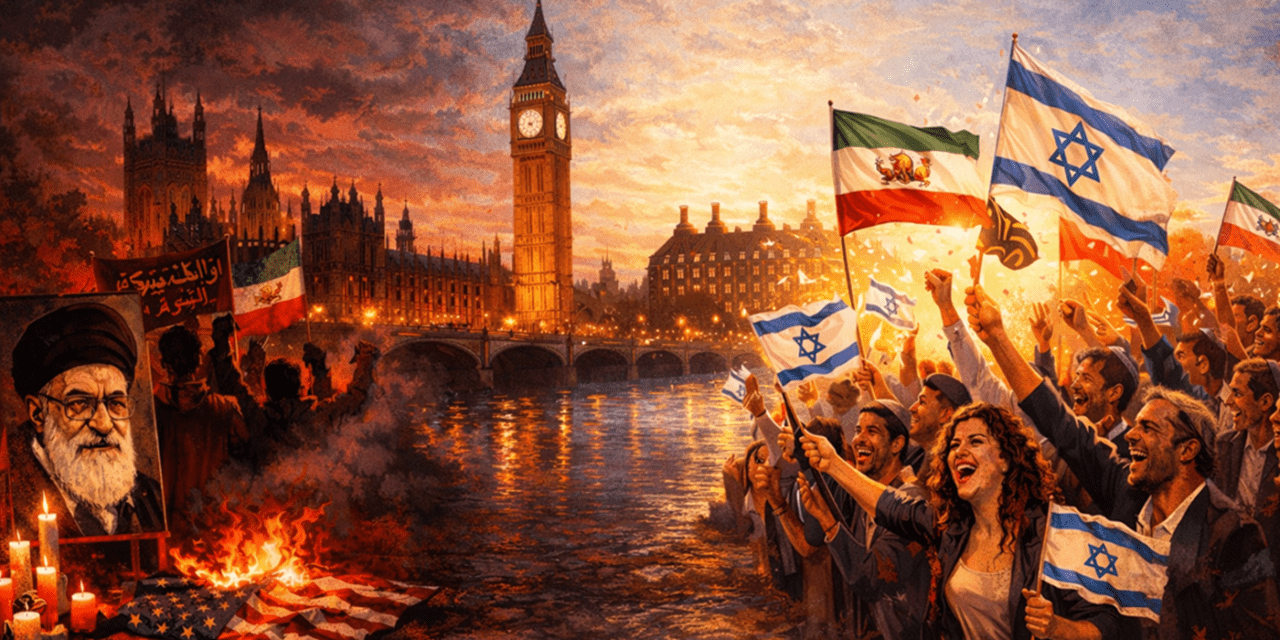
In the UK, Jews, Christians and others joined the Iranian diaspora in London, Manchester, Leeds, Glasgow, and other cities across the UK to celebrate the historic milestone. But Khamenei’s death also awakened a deeply alarming momentum of support for Tehran’s regime.
At the Islamic Centre of England in north London, candlelit photos of Khamenei were placed outside, with one congregant heard shouting on video: “We will obey you Khamenei”. In Manchester, a vigil drew around 100 people. The Telegraph newspaper reported that the Ahlul-Bayt Islamic Society at Manchester University was also heavily involved in the vigil, and had promoted it as an event “honouring the Ayatollah.”
The event organisers attributed it to only “the Muslim community.” Memorial events were also held at mosques in London, Birmingham, Manchester and Nottingham.
A large sign on the table read “You can kill a man, but you can’t kill an ideology,” and another declared “We stand with the Revolution,” referring to the 1979 Islamic Revolution that established theocratic rule in Iran.
The Times reported that Islamic societies at numerous British universities also posted tributes or condolences online.
It might not come as a surprise that there are those in the UK who support the Iranian regime. But this feels different. For example, the sudden rise in the polls of the Green Party cannot be ignored. Last Saturday, the deputy leader of the Green Party was filmed at a pro-Iranian regime rally where chants of “Death to Israel” and “Death to the IDF” were heard.
Alongside flags waved in support of the repressive regime, members of the crowd chanted “Death to America”, “Allahu Akbar!”, “Khamenei you make us proud!”, “martyrs” and “baby killers!”
An American flag was stamped on and later set alight, as was the Lion and Sun flag, the banner symbolising Iranian freedom.
In a social media post on Twitter/X on Sunday 1 March, Mothin Ali insisted he was “proudly anti-war,” accusing the US and Israel of a “deplorable” and “unilateral decision, in the midst of negotiations, to kill the Iranian leader.”
MothinAli is deputy leader of a now mainstream party that, if it continues its current trajectory, could be in power in the next election.
But this is just the “tip of the iceberg.”
These protests in turn demonstrate support for the IRGC (Islamic Revolutionary Guard Corps), which the UK government has refused to ban as a terrorist organisation. This is shameful inaction and has enabled support for terror to flourish on UK streets.
Among the groups listed as organisers of the Saturday rally was the “Islamic Human Rights Commission,” which was described by William Shawcross in his 2023 Independent Review of the Prevent programme as “an Islamist group ideologically aligned with the Iranian regime.” In a press release on Sunday, the IHRC mourned the passing of Khamenei, whom they described as “a rare role model… an erudite, principled, spiritual and stoic individual” and “someone who resisted oppression and stood on the right side of history.”
On 15 March the IHRC is again due to host its annual “Al-Quds Day” march through central London. The concept of Al-Quds Day was created by former Iranian Supreme Leader Ayatollah Ruhollah Khomeini in the 1980s. It takes place on the last Friday of Ramadan, and the London march usually takes place on the final Sunday. Adherents use the day to call for the destruction of Israel and the “liberation” of Jerusalem. The day is expected to draw even more support from those sympathising with the Iranian regime this year, and failure to ban the IRGC is allowing support for Iranian terror to go ahead without consequences.
Speaking on GB News’ Breakfast Show this week, CUFI’s Alastair Kirk said, “This is a battle between good and evil… you are either on the side of the Ayatollahs and the tyrants of Tehran, or you are on the side of the Iranian people. We must choose a side.”
But choosing sides is something that Prime Minister Keir Starmer has struggled to do since war broke out last week. Even though the UK has reluctantly given permission for our ally, the United States, to use British air bases for certain defensive operations, Number 10 has stopped short of giving full support to the US and Israel in their military operation against the Iranian regime.
Starmer claims that it is in the national interest – perhaps because there were 20 foiled terror plots linked to the Iranian regime in the UK last year, and Iranian-linked terror cells are known to be on British soil.
But allowing the IRGC, and its support, to be legal in the UK is not standing up to terror. Britain’s weak response to the Iranian regime is creating a culture of acceptance towards Islamic extremism – and the more that is ignored, the more it will grow and embolden its supporters.
This appeasement does nothing to support the Jewish people in Britain. On Friday, four men were arrested in the UK on suspicion of spying on the Jewish community for Iran. It comes as the Community Security Trust (CST) issued renewed security advice to synagogues and other Jewish sites in Britain over concerns relating to the Middle East conflict.
Perhaps the most telling example of appeasement this week was at the “Big Iftar” Ramadan event in Westminster Hall, where the Prime Minister addressed a large audience of Muslims and made a great effort to assure those listening that the UK was not involved in the US-Israel joint operation.
“But on Iran, I want to make it clear: the UK was not involved in the offensive strikes by the US and Israel, and that remains the case,” the PM said, prompting a standing ovation.
Why did the Prime Minister feel the need to make that point so clearly? Why not just state the government’s policy?
The fact is, appeasement is not a sign of putting the national interest first. It is a sign of weakness to the Tehran regime and its allies.