Churchill faced nothing but obstruction from Parliament and even his own Cabinet regarding resolving the issue of Jewish refugees. But Churchill wasn’t a dictator, so he was often overruled on matters that were not strategic military decisions. Nevertheless, he persisted in instructing against refusing entry of Jews to Palestine.
Churchill demonstrated sympathies towards the Jewish people very clearly during the wartime years. For example, he pushed for the arming of Jews in Palestine, but was blocked by his Cabinet. By 1941, Churchill was taking steps to prevent the 1939 White Paper’s goal of an Arab majority in Palestine, even defending illegal immigration. Eventually, in 1943, Churchill was able to effect change in British policy and enabled several thousand Jews to enter the Mandate of Palestine from the Balkans, irrespective of quotas and in 1944 he gained government support for the establishment of a military contingent of Jews from Palestine.
Before this, in 1942, soon after the mass deportations to the extermination camps were underway, Churchill declared before the House of Commons on 8 September that the Nazis were engaged in “the most bestial, the most squalid and the most senseless of all their offences…. This tragedy fills me with astonishment as well as with indignation, and it illustrates as nothing else can the utter degradation of the Nazi nature and theme.” Churchill famously promised, “When the hour of liberation strikes in Europe, as strike it will, it will also be the hour of retribution.”
Churchill followed this speech with a letter dated 29 October 1942 to William Temple, the then Archbishop of Canterbury: “The systematic cruelties to which the Jewish people—men, women, and children—have been exposed under the Nazi regime are amongst the most terrible events in history, and place an indelible stain upon all who perpetrate and instigate them. Free men and women denounce these vile crimes, and when this world struggle ends with the enthronement of human rights, racial persecution will be ended.”
When Churchill received reports of the nature of the Auschwitz extermination camps in June 1944, Churchill immediately told his Foreign Secretary, Anthony Eden: “There is no doubt that this is probably the greatest and most horrible crime ever committed in the whole history of the world, and it has been done by scientific machinery by nominally civilized men in the name of a great State and one of the leading races in Europe….It is quite clear that all concerned in this crime who may fall into our hands, including the people who only obeyed orders by carrying out the butcheries, should be put to death after their association with the murders has been proved.”
Sir Martin Gilbert wrote, “Normally, he would have said, ‘Bring this up to War Cabinet on Wednesday,’ or, ‘Let us discuss this with the Air Ministry.’ Instead, he wrote to Eden on the morning of 7 July: ‘Is there any reason to raise this matter with the Cabinet? Get anything out of the Air Force you can, and invoke me if necessary.’”
For various disputed reasons, the bombing of Auschwitz and serving railway lines never happened in July 1944, but when all is said and done it was too late to save all but a final 100,000, says Gilbert.
Britain’s broken promise
As Leader of the Opposition after electoral defeat in July 1945, Churchill was unhappy about the way the post-war Labour government approached the original principles of the Balfour Declaration.
On 14 May 1948, after Britain’s termination of the Mandate of Palestine, David Ben-Gurion proclaimed independence and the State of Israel was immediately recognised by the United States and Soviet Union. The invasion by the Arabs following British withdrawal immediately followed. But there was no recognition by Britain of the newly established State of Israel. Churchill was hugely critical, telling the House of Commons, “It seems to me that the Government of Israel which has been set up at Tel Aviv cannot be ignored and treated as if it did not exist.”
On 3 October 1948, during a speech at a Conservative Party rally in North Wales, Churchill declared, “The Socialists, more than any other Party in the State, have broken their word in Palestine and by indescribable mis-management have brought us into widespread hatred and disrepute there and in many parts of the world.’”
By 10th December, nineteen countries had recognized Israel, but Britain was still not among them. Recognition was delayed until 29 January 1949.
Standing before the House of Commons as leader of the opposition, Churchill declared, “The coming into being of a Jewish State in Palestine is an event in world history to be viewed in the perspective not of a generation or a century, but in the perspective of a thousand, two thousand, or even three thousand years.”
“An old Zionist like me”
Churchill had undoubtedly played a crucial role in the establishment of the Jewish state and his support for Israel was unceasing. Less than a year after Israel’s independence, Churchill had assured Jewish leaders in New York::
“Remember that I was for a free and independent Israel all through the dark years when many of my most distinguished countrymen took a different view. So do not imagine for a moment that I have the slightest idea of deserting you now in your hour of glory.”
Churchill constantly referred to himself as “a Zionist from the days of the Balfour Declaration”. In a letter to his old friend Chaim Weizmann just after Churchill became prime minister again in 1951, he referred to himself as “an old Zionist like me.”
Concerning Jerusalem, Churchill’s position was clear, famously stating to British diplomat Evelyn Shuckburgh in 1955, “You ought to let the Jews have Jerusalem; it was they who made it famous.”
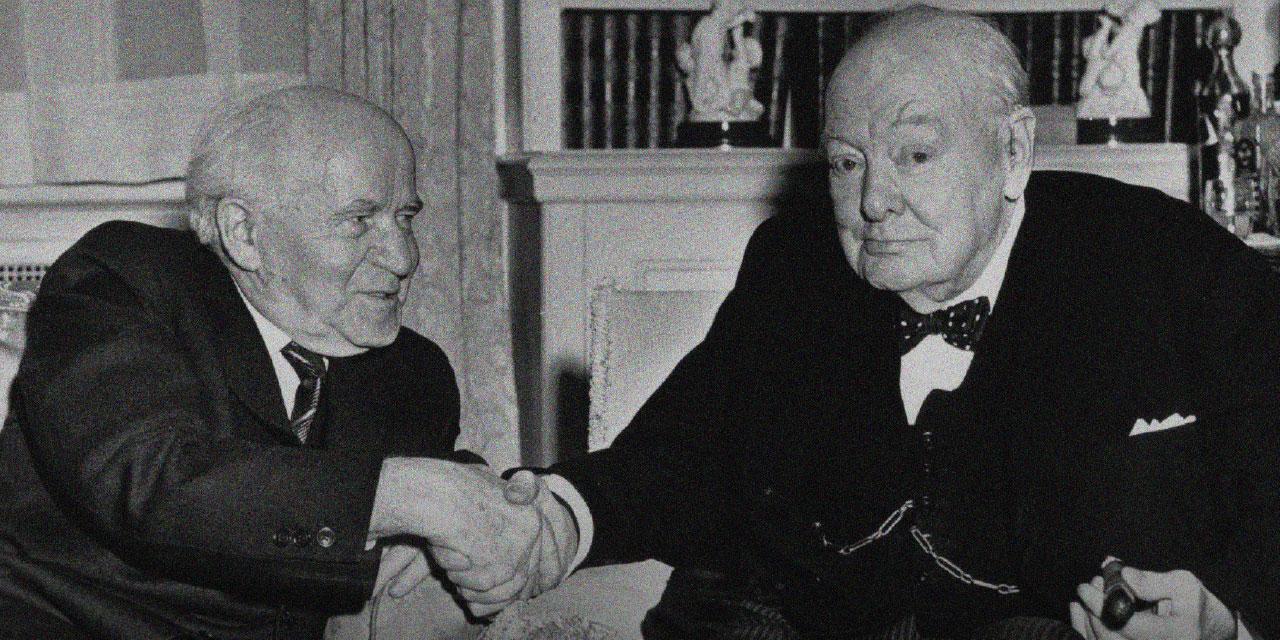
When 86-year-old Churchill met David Ben-Gurion in London in 1961, he gave Israel’s first Prime Minister a copy of the article he had written 30 years prior, Moses: the Leader of a People.
Ben-Gurion would have read its opening words in which Churchill referred to the Bible’s description of Moses as “an apt expression of the esteem in which the great leader and liberator of the Hebrew people was held by the generations that succeeded him.”
At this historic meeting sat two aged leaders, both having led their respective peoples through a fight for survival to deliverance and freedom. Whilst both would humbly refuse to be compared to Moses, one cannot help but recognise the calling of God upon their lives to fulfil God’s purpose concerning Israel and defeat the great evils that sought to wipe out the Jewish people from the face of the earth.
For this, future generations are eternally grateful for the life and legacy of Sir Winston Churchill and why he is today regarded as the greatest Briton that ever lived.
________________________
Alastair Kirk – Christians United for Israel

This article first appeared in the CUFI UK Torch Magazine (Issue #16, August 2020)
To receive future issues and access to all past issues of the Torch Magazine, please subscribe for free at www.cufi.org.uk/subscribe