
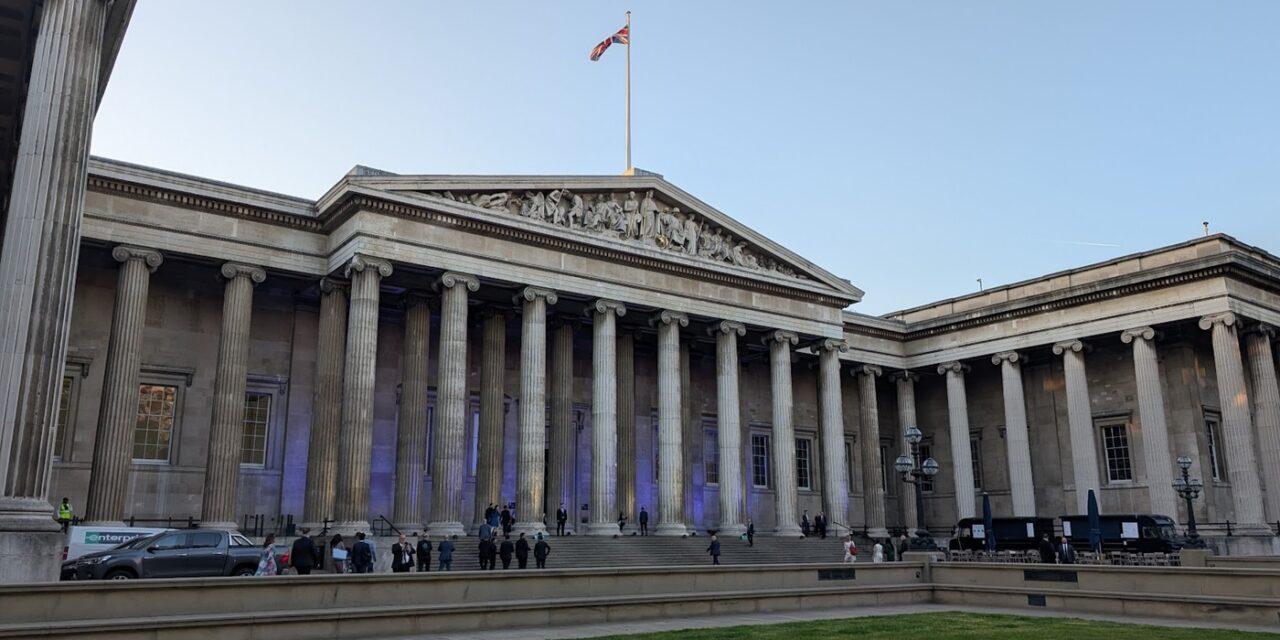
The British Museum this week cancelled a history lecture as part of the UK’s first nationwide Jewish Culture Month over “security concerns” after it emerged that pro-Palestinian protesters were planning to disrupt the event. The London event was to feature a lecture on the ancient Jewish kingdoms of Israel and Judea.
The decision by the British Museum is a watershed moment. Before challenging their decision, let us address the protest itself.
Let’s be clear: the opposition to this event is blatant antisemitism. Thursday’s planned event was titled “Ancient Israel and Judah in the British Museum”. It featured a lecture by Dr Paul Collins, the museum’s Keeper of the Middle East Department, examining the archaeology and history of the ancient kingdoms of Israel and Judah through artefacts held by the museum.
The reality is that the Jewish people have a direct indigenous connection to the Holy Land that spans more than 3,000 years. The British Museum is a trove of historical evidence supporting this fact. Even though it was far from being a political lecture, the danger for pro-Palestinian activists is that this lecture would have undermined the very basis of their anti-Israel narrative. It shows that these activists are not really opposed to the State of Israel’s “actions”, as they might want us to believe; they are concerned with delegitimising the Jewish connection to the Land and wiping out Israel from historical memory, past and present.
Historical evidence proves what antisemites fear most – Israel’s existence is ancient and undeniable. Palestinian revisionism relies on a distortion of history. Even though the region has been known as “Palestine” since Roman times (in an attempt to delegitimise the Jewish connection), it was never the title of a Palestinian Arab nation or state, nor was it synonymous with Arab nationalism until the 1960s. In fact, the facts prove the opposite. Even when the State of Israel gained independence in 1948, Jews and Arabs were both referred to as “Palestinian” because of the term that had been used during Ottoman occupation. But the Jewish connection cannot be denied. Wherever you dig in the Holy Land, Jewish history cries out. And the British Museum’s collections confirm this.
Those who protest this reality have either been completely duped by Palestinian propaganda, or they are too hateful to want to be educated – or both. They claim to be “anti-Zionist”; they are not. As we have been saying all along, they are anti-Jewish. Mockers online were claiming that Israel’s history is only 78 years old; this shows how deceived they are and why an institution like the British Museum is needed.
Opposition to the planned lecture singles out Jewish culture as the only culture that cannot be celebrated in Britain. What message does this send to the Jewish community, which is already facing a crisis of antisemitism in the UK? And what does it say about the UK and the values this nation is supposed to uphold?
The British Museum is funded by the UK government and owned by the British public. Historian Simon Schama branded the decision “cowardice”. Veteran BBC journalist John Simpson called the move “pathetic”. Author Simon Sebag Montefiore said the postponement reflected “dark times”.
The Board of Deputies, which is organising the UK’s first Jewish Culture Month, said: “It is highly regrettable that individuals have sought to deliberately disrupt a Jewish Culture Month event celebrating Jewish cultural heritage at the British Museum. Jewish Culture Month has seen many of Britain’s great cultural institutions partner with us in celebration of British Jewish culture, community and creativity, and we will not allow the actions of extremists to prevent the British public from enjoying these events. We will be working with our partners at the British Museum to reschedule this event as soon as possible.”
Shimon Cohen, a leader in the Jewish community, said: “The British Museum prides itself on being a ‘meeting place for cross-cultural exchange and engagement and to remove barriers to participation’. They declare how they ‘build relationships with community partners that deepen both collection and community knowledge, celebrate the contribution of our communities, and affect positive societal change’. One community does not count. The Jewish community is now exposed to terror plots, arson attacks, stabbings, and abuse. Synagogues and Jewish schools around where I live have security guards and police patrols, with families constantly fearful. And what is the reaction from a leading museum, funded by the UK Government and owned by the UK public? That anything connected with Jews is simply not worth the risk. Why has our country descended into mob rule? Why are we signalling that intimidation, vitriolic abuse, and violence against Jews works?”
Following the backlash, the British Museum is understood to be rescheduling the lecture for a later date. Security is paramount, but British institutions such as the Museum should not cower to extremism and intimidation. Capitulation to antisemitism is a history lesson in itself, and one that, if not learned, is only going to normalise Jew-hatred to a point where even our Western pillars of freedom and truth cannot stop the hate.