So far in this series, we have used Scripture to disprove the false teaching of Replacement Theology. However, Replacement Theology, also known as Supersessionism, involves more than simply misinterpreting the Bible. There is also a spirit behind it. This spirit uses Replacement Theology as a weapon to undermine the legitimacy of Israel. This is at the very centre of Satan’s plans concerning God’s people. Psalm 83:4 says, “They have said, ‘Come, and let us cut them off from being a nation, that the name of Israel may be remembered no more.’” It is vital that we understand that this is the intended goal of Satan, and Replacement Theology is a tool that he is using to mislead many Christians.
Just as Israel’s enemies seek to erase Israel and the Jewish people, Satan has deceived Christians into believing that God Himself has removed Israel. The spirit that demonises and delegitimises Israel and the Jewish people, with the ultimate goal of destroying them, is the same spirit that uses Replacement Theology to turn Christians away from loving Israel. It is time to expose and rebuke this spirit for what it is.
Replacement Theology teaches that the Church has replaced or superseded Israel, and that the promises given to the Jewish people have been annulled. While the New Covenant fulfils the Mosaic Covenant, it does not replace the covenant God made with Abraham, Isaac, Jacob, and their descendants. As we covered earlier in this series, the Abrahamic Covenant includes the Land of Israel, given to the Jewish people as an eternal inheritance.
Jeremiah 31:35-36 affirms that as long as the sun, moon, and stars endure, Israel will never cease from being a nation before God:
“Thus says the Lord, Who gives the sun for a light by day, The ordinances of the moon and the stars for a light by night, Who disturbs the sea, And its waves roar (The Lord of hosts is His name): ‘If those ordinances depart From before Me, says the Lord, Then the seed of Israel shall also cease From being a nation before Me forever.’”
The Spirit of Amalek – Ancient Examples
Since God established His covenant with Abraham, promising to make him a great nation, this spirit that seeks to ‘replace’ or ‘remove’ Israel has been active throughout history. One way Scripture identifies this opposition is through the spirit of Amalek.
Amalek was the grandson of Esau. Even though Jacob, who the Lord renamed Israel, and his brother Esau reconciled, avoiding a conflict between the two, Amalek retained a jealous spirit and became Israel’s arch enemy.
The Amalekites became the first people to attack Israel after the Exodus, as they journeyed toward the Promised Land. Significantly, the spirit of Amalek appears at other crucial turning points in Israel’s history, repeatedly attempting to hinder God’s purposes for His people.
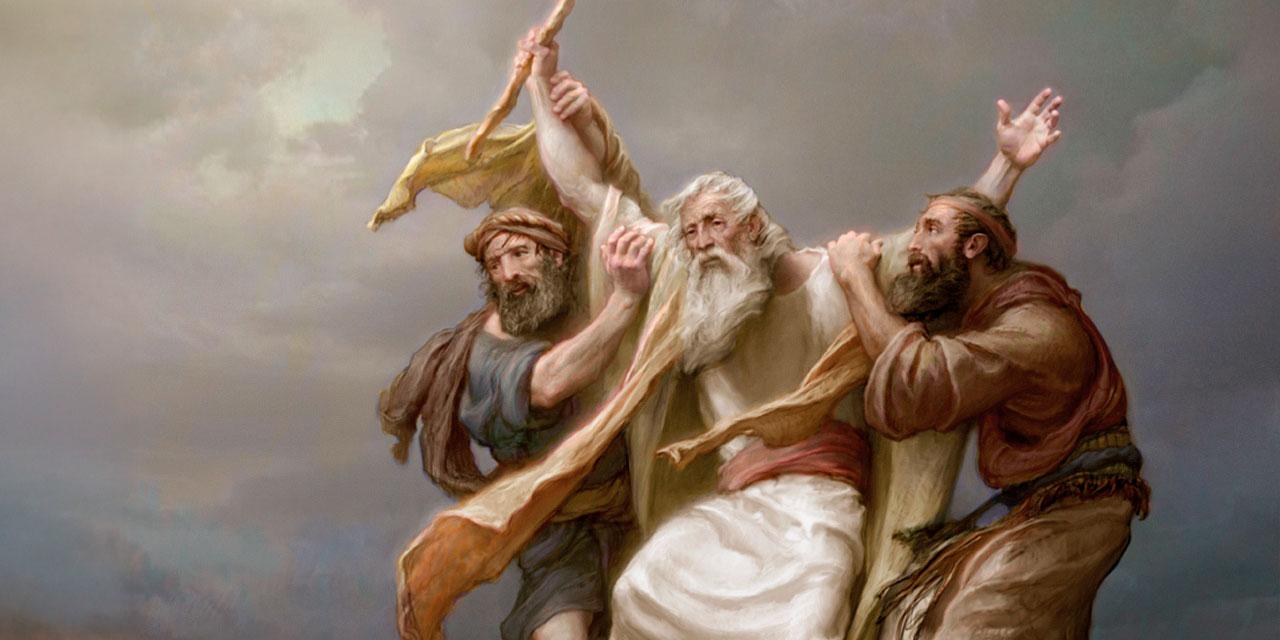
One such moment occurred at Rephidim. Moses instructed Joshua to lead Israel’s army while Moses, Aaron, and Hur went up the hill to pray. Their intercession played a decisive role in Israel’s victory over Amalek. Exodus 17:11–12 records that when Moses held up his hands, Israel prevailed, but when his hands dropped, Amalek gained ground. Aaron and Hur supported Moses’ hands until sunset, ensuring Israel’s victory. This account reminds us that Israel’s survival has always involved a spiritual battle. As the Apostle Paul later penned, “For we do not wrestle against flesh and blood, but against principalities, against powers, against the rulers of the darkness of this age.”
We see a similar spiritual awareness from David as he faced the Amalekites just before he became King of Israel. After the Amalekites raided the Israelite camps at Ziklag and captured the women and children, the Bible says that David “strengthened himself in the Lord,” and he sought the Lord for guidance before responding. God instructed David to pursue and overtake the enemy and rescue the hostages. Amazingly, this took place near Kibbutz Be’eri and Kfar Aza, two locations where Hamas carried out the October 7th terror attacks against the Jewish people, taking many captive.
Haman also descended from Amalek. He plotted a genocide of all the Jews in Persia, but was prevented through similar spiritual intercession. Before Esther approached the king, she called upon all of Israel to hold a three-day fast. Like Moses on the hill and David before liberating the hostages, Esther knew that this battle was spiritual and therefore required a spiritual response.
The spirit of Amalek can be seen consistently in these examples. Esau was about to attack the Israelites as Jacob prepared to enter his inheritance. Amalek attacked Israel at Rephidim just before God gave the Law at Mt Sinai. The Amalekites attacked David just before his kingship. Haman planned to massacre all Jews in Persia, but their deliverance paved the way for their return from exile.
In more recent history, the attempted annihilation of Jews during the Holocaust was followed, only three years later, by the rebirth of the State of Israel. Immediately after Israel declared independence, surrounding Arab armies attempted to destroy the newly reborn nation. Once again, we see opposition arising at pivotal moments in Israel’s restoration, and a jealous spirit trying to prevent God’s purposes from unfolding.
The Spirit of Replacement Ideology – Modern Examples
The spirit behind Replacement Theology is also visible outside the Church. While Replacement Theology seeks to replace Israel biblically, the same spirit often manifests politically and culturally. This is why many Christians who accept Replacement Theology are more easily influenced by anti-Israel political ideology.
Standing with Israel is not a political issue; it is a Bible issue. Understanding what the Bible says about Israel protects Christians from being deceived by the spirit that is behind the anti-Israel agenda. Even if not simply theological, we could describe any attempt to replace or remove Israel and Jews as the same ‘spirit of replacement ideology’. Let us now look at four examples that illustrate how this spirit of replacement ideology appears in contemporary contexts. Christians who love Israel and reject Replacement Theology will easily identify that Replacement Theology shares the same spirit as these examples and is even complicit in them.
1. Palestine, not Israel
The term ‘Palestine’ has evolved significantly over the past two millennia. After British Empire forces defeated the Ottoman Turks in the Holy Land in 1917, Britain adopted the term ‘Palestine’ for its Mandate territory; however, at the time the word ‘Palestinian’ referred to both Jews and Arabs living in the region. Only after the State of Israel’s establishment did the term become closely associated with Arab nationalism. But where does the word ‘Palestine’ originate?
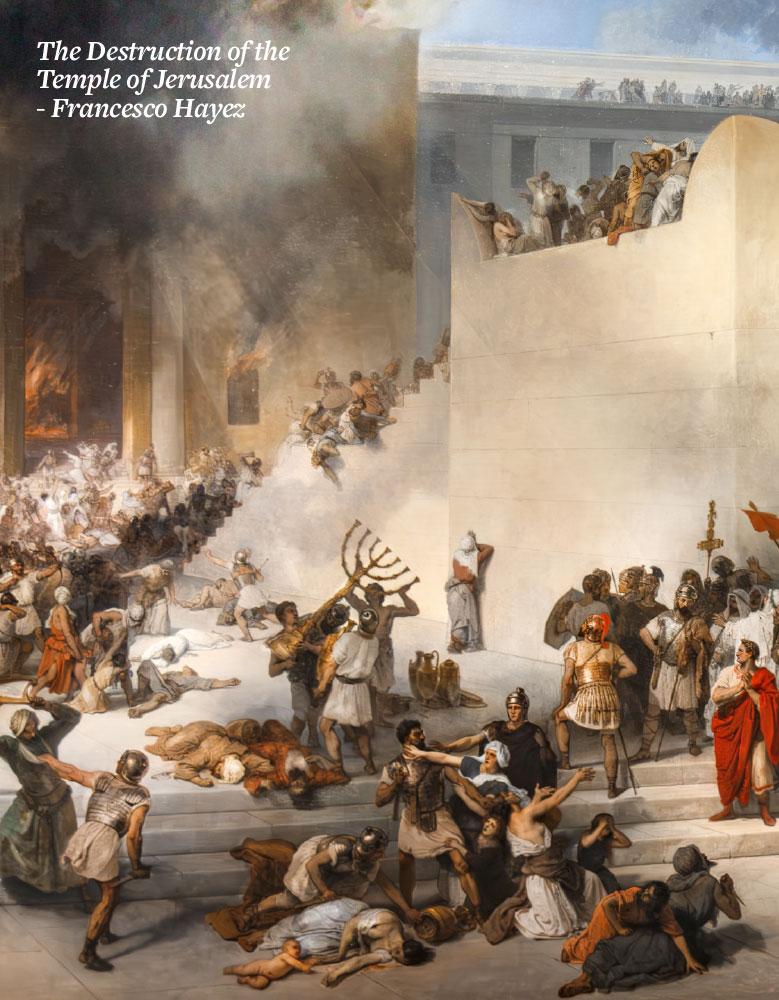
Historically, the name ‘Palestine’ originated in the second century AD when the Romans renamed Judea ‘Syria Palaestina’ following the Jewish revolt of AD 135. They also renamed Jerusalem. This was intended as a political punishment for the Jews, in an antisemitic attempt to sever Jewish identity from the land. In ancient Israel, the word ‘Philistia’ (Hebrew: Peleshet) or ‘Palaistina’ (Latin) referred only to the coastal region inhabited by the Philistines, not the Jewish heartland. The Philistines were Israel’s enemy, and the Bible says that they would be destroyed as a people group. The Philistines were not Arabs or Muslims and had no relation to modern Palestinians. In other words, the Romans named Judea after the name associated with Israel’s enemies.
Here we clearly see the spirit of replacement ideology. The Romans introduced the word ‘Palestine’ to erase Israel’s identity and delegitimise the Jewish people from their inheritance.
Similar patterns can be seen today when geographic or historical Jewish connections are replaced or removed from public recognition. When the British Government recognised a ‘State of Palestine’ in September 2025, their very first action was to change place names on the map on the government website. They renamed Bethlehem to ‘Bayt Lahm’ and Hebron to ‘Al Khalil’. They split Jerusalem into two, placing Judaism’s most holy sites in the hands of Islamist extremists who want to see the Jewish people wiped out.
2. Jesus, a Palestinian
No, Jesus was not a Palestinian. This claim has moved from fringe rhetoric promoted by Palestinian Islamists to mainstream churches in the West. This reflects another expression of replacement ideology.
Jesus was born in Judea to Jewish parents in the town of David. Jesus lived as a Jew, died as a Jew, and will return as the Lion of Judah. Reframing Jesus as a Palestinian is becoming increasingly common practice in churches that teach Replacement Theology, which often accompanies theological positions that minimise Jesus’s Jewish identity. In turn, this almost always leads to a pro-Palestinian bias against Israel taking root.
The modern term ‘Palestinian’ refers to Arab populations in the Palestinian territories. However, at the time Jesus was on earth, Arabs did not live in the Land of Israel. They lived primarily in Arabia, and Islam would not emerge until six centuries later.
Christians who describe Jesus as a Palestinian have bought into an antisemitic campaign against Israel. Known as ‘Palestinian Liberation Theology’, it misappropriates Jesus as a Palestinian political figure resisting Jewish authority or Roman rule in a hostile attempt to demonise Israel. It uses modern political narratives like Jesus living ‘under occupation’ to accuse Israel of mistreating Palestinians. Palestinian Muslim leaders, who have no authority whatsoever to teach Christians, know that by denying the Jewishness of Jesus they can further undermine the Jewish connection to the Land of Israel. It tries to redefine Jesus as a political freedom fighter who stands against Israel. This deception is rampant in pro-Palestinian advocacy but is also misleading many others by distorting both historical and Biblical truth. Sadly, it also risks separating Christians further from the Jewish roots of our faith and creating a wider chasm between Christians and Jews.
3. The United Nations and de-Judaification
In 2016 and in subsequent years, UNESCO and the UN General Assembly passed resolutions that renamed Jewish holy sites with Islamic terminology, thus denying Jewish historical connections to these locations. These resolutions referred to the Temple Mount exclusively by its Islamic name, al-Haram al-Sharif, or the Al-Aqsa Mosque, instead of its Hebrew or English names (Har HaBayit or The Temple Mount). They also labelled the Tomb of the Patriarchs in Hebron and Rachel’s Tomb in Bethlehem as “Palestinian sites” and often used the phrase “occupying power” to describe Israel. The Western Wall is only referred to as “Western Wall” in quotes, undermining its description. This deliberate replacing of Jewish sites is a further example of the spirit of replacement ideology that seeks to revise Jewish historical and religious connections to the land.
4. Jews in Israel are not real Jews
The statement that the Jews living in Israel are not real Jews is a lie from the pit of hell. Sadly, the slur that Jews living in Israel are not authentic descendants of ancient Israel is increasing in popularity. Some Christians are being misled by antisemitic fringe groups such as the ‘Black Hebrew Israelite’ movement, who twist the Bible, and believe that African Americans are the real Jews. Jewish populations worldwide, including those living in Israel, represent a diverse range of ethnic backgrounds, including communities from Europe, the Middle East, Africa, Central Asia, and the Americas. However, purporting that Jews are not real Jews is antisemitic to the core.
It is another example of the spirit of replacement ideology, and is another method that Satan is using to delegitimise the Jewish people’s claim to the Land of Israel. This heresy can be easily debunked genetically, genealogically, and numerically.
There is strong peer-reviewed genetic research that shows genetic continuity among Jewish populations, despite centuries of dispersion. Genetics only show shared ancestry, but Jewish identity is also religious and cultural.
Genealogically, Jewish identity has been maintained through continuous religious tradition dating back thousands of years; multitudes of historical records, rabbinical lineage documentation, as well as strong cultural and communal preservation across communities.
The Jewish population of modern Israel reflects deep continuity with the ancient Jewish people through shared ancestry, preserved genealogical traditions, and the demographic gathering of Jewish communities from across the diaspora. While Jewish identity has always included religious and cultural dimensions beyond biology, genetic and historical research strongly supports the enduring connection between many Jewish populations and their origins in the ancient Land of Israel.
Many Holocaust survivors found refuge in the newly re-established State of Israel. If these people were not Jews, then the victims of the Holocaust were not Jews either, nor would be the victims of the Russian pogroms that preceded the Holocaust. Yet those who say Jews in Israel are not real Jews never accuse Hitler of misidentifying his victims.
The biggest defence against this antisemitic lie is the Bible. Surely, if there was to be a fake Israel, the Bible would have prophesied about it and certainly would have warned against it. Instead, the opposite is true – the Bible prophesies that the Jewish people would be scattered and then would return to the Land of Israel, just as has happened and is happening.
The Proclamation of Truth
There is an ongoing battle for truth. The Enemy of Israel still wants to demonise, delegitimise, and destroy the nation of Israel. Replacement Theology is one of Satan’s most important tactics because it involves deceiving the Church. It turns two divine purposes within God’s plan – the Church and Israel – against one another and feeds the antisemitic pattern of turning Christians against Jews.
One way to counter the spirit of replacement ideology is to declare the Word of God, which is sharper than a two-edged sword. As Christians, we can do this by affirming with full authority what the Bible says about God’s Covenant with His people. Replacement Theology cannot be disarmed by theological and academic intellect alone; it is a spirit that must be brought down by the power of God’s Word. May the Lord give us all discernment for the age we are in and equip us with boldness to reject the lies of the evil one and speak the truth with conviction.
This article first appeared in the CUFI UK Torch Magazine (Issue 30, Winter 2026).
To receive future issues and access to all past issues of the Torch Magazine, please subscribe for free at www.cufi.org.uk/subscribe