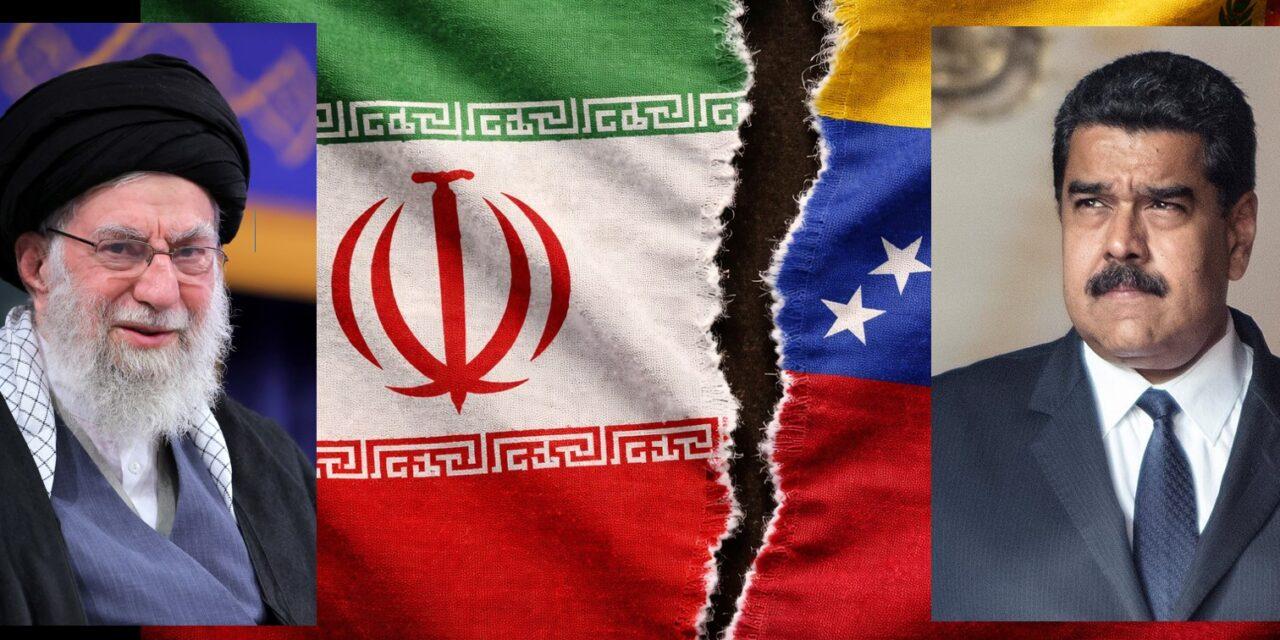
The toppling of Venezuela’s dictator, Nicolás Maduro, sent shockwaves throughout the world, but nowhere more so than in Tehran, where a weakened Iranian regime, that has been subject to major civilian demonstrations this week, would have been anxiously looking on.
There is a strong link between Venezuela, Iran, and the Iranian terror proxy, Hezbollah. Under Maduro’s leadership, Venezuela developed mutually beneficial relationships with both Iran and Hezbollah.
While it is known that Maduro destabilised the country through its connections with terrorist-criminal groups and drug cartels, causing far-reaching implications for its people and for US security, it is lesser known how this has emboldened Iran. The Iranian regime has promoted Venezuela as one of its main partners in its “axis of resistance”. Ideologically, the two regimes share anti-West values that have brought the two countries into closer collaboration, and both have an interest in weakening US national interests.
The regimes in Venezuela and Iran have shared ideology
In a propaganda poster produced by the Iranian Ayatollah Ali Khamenei, Maduro is featured alongside prominent pro-Iranian leaders, such as the now-deceased Hezbollah leader Hassan Nasrallah and ousted Syrian dictator Bashar al-Assad. The bond was strengthened in 2022 when the two countries signed a 20-year cooperation agreement. According to Iran state media, Maduro told Iranian leadership that Venezuela was part of the ‘axis of resistance’ and that it “exists throughout the world; it exists in Africa, in Asia, in the Middle East, in Latin America and in the Caribbean.”
The two parties have recently sought closer economic ties as a way to evade US sanctions, and Iran has invested heavily in repairing Venezuela’s oil refineries. But when Iran and Venezuela boast mutually of being an “axis of resistance”, it doesn’t just stop with anti-American sentiment or economic cooperation. When Venezuela’s interim president was sworn in this week, she was very quick to blame “Zionists” for Maduro’s removal. She means Jews. It should not surprise us that if you shake the hand of the antisemitic Iranian regime, you will share common interests that go beyond just oil.
Venezuela is Iran’s Latin American weapons depot and arms trafficking hub
In Venezuela itself, the IRGC (Islamic Revolutionary Guard Corps) is highly active. The IRGC is a proscribed terrorist organisation in the United States and many other countries of the world, yet the United Kingdom has shamefully not yet banned it. When a Venezuelan-owned cargo plane was detained in Argentina in 2022, it had five Iranian crew members, including an ex-IRGC commander and IRGC-Quds Force members, on board. Meanwhile, under Maduro’s watch, the Iranian regime has established production facilities for its military drones that have been used to inflict terror against Israel and in Ukraine. Tehran has effectively turned Venezuela into its Latin American weapons depot and arms trafficking hub. Unsurprisingly, Venezuela has also bought some of these armed drones. It has also purchased Iranian-made speedboats armed with anti-vessel missiles.
Hezbollah’s drug trafficking and money laundering activities in Venezuela fund Iranian terror
To understand the complete picture of Iran’s operations in Latin America, we need to look at Hezbollah. The Iranian proxy has used Venezuela as a base, operating a criminal-terror network throughout South America. Largely driven by narcotics trafficking, Hezbollah operatives travel between Lebanon and Venezuela, and many have roots in Venezuela’s sizeable Lebanese community. These Hezbollah-linked agents launder money that lines the pockets of the Iranian regime in Tehran and sponsors their terror activities.
According to US government sources, Hezbollah moves as much as $400 million worth of cocaine annually through networks in Latin America, especially via Venezuela and Colombia. Some expert assessments suggest this number is likely higher in more recent years due to expanded trafficking efforts and diminished Iranian funding. Combining drug trafficking, money laundering, and other illicit revenue streams, some analysts estimate Hezbollah-linked activities to be around $1 billion per year. And open-source analysts suggest 30–40% of Hezbollah’s total annual revenue comes from its involvement in the drug trade and money laundering enterprises.
By Maduro allowing Hezbollah to operate from Venezuela, it also places Iranian terror networks in closer proximity to the United States – a concern that will not have gone unnoticed by Washington. This also puts the Jewish community in South America at greater risk. In 1992, Hezbollah, with Iranian support, bombed the Israeli embassy in Argentina, and two years later Hezbollah terrorists attacked a Jewish community centre in Buenos Aires.
Iran needed Venezuela in its efforts to destabilise the West and eradicate Israel
Under Maduro’s dictatorship, Venezuela has become a strategic partner for Iran in Tehran’s efforts to destabilise the West. Iran also regarded Venezuela as an important part of the ‘axis of resistance’, shaped around the Iranian regime’s ultimate goal of destroying the State of Israel. With a weakened Hezbollah in Lebanon due to Israel, Tehran depended even more on Caracas as a stream of terror funding and a partner in its efforts to rebuild its hampered military infrastructure. But the dramatic capture of Maduro last week, ordered by President Trump, would have shaken Iranian leaders. While the future of Venezuela is still uncertain, it was another dent in the Iranian regime both practically and ideologically, and a successful step forward in guaranteeing the security of both the United States and the State of Israel.