
“If the BBC and other major outlets want to regain credibility, they must stop letting the comfortable, lazy “both sides” shorthand replace proper investigative journalism that aims to present the truth. Anything less favours confusion over clarity and almost always aids terrorists and not the victim.”
As Hamas was massacring Gazan civilians and pushing the boundaries of the latest fragile ceasefire, the BBC and other media outlets were up to their old tricks, framing Israel’s response as the cause of this week’s escalation in a vain attempt to present “both sides”.
This week Hamas killed two Israeli soldiers in an area controlled by Israel. This area of Israel’s control was in line with the terms of the ceasefire agreement. That agreement almost collapsed as a result of the Hamas attack. IDF retaliated with precision air strikes on Hamas targets, then announced it was returned to the terms of the ceasefire.
That should have been the story that the BBC and others published. But they just can’t help themselves. They seem intent on blurring the main cause of the breach and exaggerating the response, applying neutral obscurity to present a ‘both-sidesism’. But this vagueness only aids Hamas.
According to the BBC, the problem started when Israel fired back. The BBC’s post announcing that Israel had carried out air strikes stated the following (in bold for emphasis):
“A military spokesman says Hamas carried out ‘multiple attacks against Israeli forces beyond the yellow line’ – which they say is the area Israeli troops have withdrawn to in accordance with the phase one of the US-brokered deal.”
No, BBC, the yellow line is the internationally recognised, Hamas-Israel-agreed area that was part of the ceasefire deal. It is not some vague unilateral area determined by the IDF.
The BBC didn’t stop at casting doubt about the facts of this attack. It unbelievably relayed to the world Hamas’s “commitment” to peace:
“Hamas says it is committed to the ceasefire and accused Israel of breaking it several times.”
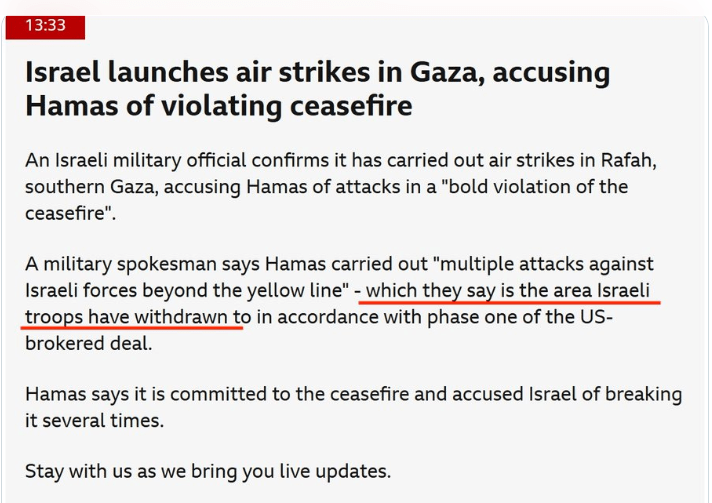
The BBC was not the only UK outlet to cast doubt over the facts. Placing “terrorists” who cross the yellow line in quotation marks only adds to the scepticism.
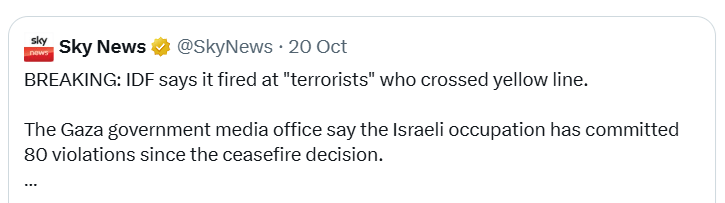
And despite almost the entire poliitical world supporting the end of Hamas’s control of Gaza, Sky News still gives credibility to Hamas sources by calling them a government:
“The Gaza government media office say the Israeli occupation has committed 80 violations since the decision.”
Notice the omission of any quotation marks, compared with its handing of the word “terrorists”
It could have been worse. France 24 not only omitted Hamas, but also blamed Israel with the following headline:
“Israeli military launches attack on Gaza despite ceasefire agreement, Israeli media reports.”
In addition to the killing of two Israeli soldiers behind the agreed ceasefire line, let’s just remind ourselves of what Hamas has perpetrated this week. Hamas publicly executed at least eight men in Gaza City whom the group said were “collaborators and outlaws”. Some of these executions were on the street in front of children and other civilians, in a clear attempt to cling to what power it has left. Hamas is also reported to be hunting down rival armed factions and tribal gangs in Gaza that are a threat to its control. Furthermore, Hamas has not yet completed the return of all remaining hostage bodies.
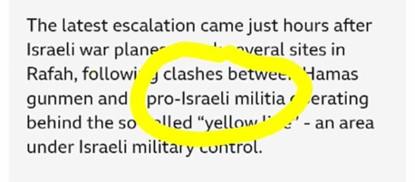
There is a rumour accusing the Gaza-based rebel groups of collaborating with Israel. Whether this is true or not, the BBC’s Gaza correspondent, used an eyebrow-raising description in one report, describing the anti-Hamas armed rebel groups as “pro-Israeli militia”. That’s a new one.
‘Both-sidesism’
Here are a few other examples blaming both sides:
“The fragile cease-fire between Israel and Hamas is under renewed strain as both sides accuse the other of violating the US-brokered agreement.” — from TIME.
“Israel and Hamas accuse each other of breaching Gaza truce amid strikes, clashes.” — from News24.
“Israel strikes Gaza after both sides accuse each other of breaching cease-fire.” — from The Independent.
“Israel launches air-strikes in Gaza days after ceasefire; Hamas, IDF accuse each other of violating truce.” — from Financial Express.
The problem with using obfuscation is that it always lets Hamas off the hook. Instead of presenting clarity over who is responsible, these outlets seem intent on presenting both sides as equally culpable, even when evidence suggests otherwise. Several sources described “both sides” as accusing the other of violating the truce. This might be true on the surface, but journalists must stop leaning on this easy neutrality and do the harder work: stating who says what, how those claims are supported (or contradicted), and what evidence exists.
If the BBC and other major outlets want to regain credibility, they must stop letting the comfortable, lazy “both sides” shorthand replace proper investigative journalism that aims to present the truth. Anything less favours confusion over clarity and almost always aids terrorists rather than the victim.