As Christians, we are taught that the battle is the Lord’s, that we wrestle not against flesh and blood, and that blessed are the peacemakers. Of course, we agree with all of these things. We also recognise that sometimes there are battles that must be fought, and God not only fights against evil, but also strengthens the hands of His people to fight.
Many of today’s Churches, particularly in established denominations, cling to a more pacifist view of Scripture and shy away from quoting Scriptures that promote the unfortunate need for war against evil. They paint Jesus as somewhat one-dimensional, being only about peace and love, but neglect to mention that He is a God of justice who judges evil.
In the Book of Revelation, we read that Jesus “makes war”: “Now I saw heaven opened, and behold, a white horse. And He who sat on him was called Faithful and True, and in righteousness He judges and makes war,” (Revelation 19:11).
Zechariah 14:3, likewise, speaks of a future “day of battle” that Jesus will be involved in: “Then the Lord will go forth, and fight against those nations, as He fights in the day of battle.”
There are also numerous times in the Bible where God commands His people to go to war, including giving orders to totally eradicate those who oppose Him. God promises to “curse” entire nations that curse Israel. Cursing isn’t a light punishment. History attests that empires and people groups have been completely wiped off the face of the earth because they opposed God and His people.
But alas, we keep getting told: “That’s the God of the Old Testament, not the New Testament.”
It is wrong to divorce Jesus and the New Testament from the God of the Old Testament. God is a God of love, and Jesus is the Prince of Peace, but God also judges the ungodly and battles against evil.
We want to be very clear here: there is no difference between the Old Testament God and the New Testament God. There is no difference between the Old Testament God and Jesus. They are one. God is the same yesterday, today and forever.
“For I am the Lord, I do not change; Therefore you are not consumed, O sons of Jacob.” (Malachi 3:6)
“Jesus Christ is the same yesterday, today, and forever.” (Hebrews 6:13)
Is it wrong for Christians to support war?
It should be noted that at Christians United for Israel, we are continually praying for peace. We do not wish for war. We pray daily for the peace of Jerusalem and for an end to these wars. But we also have the courage to stand up against evil.
In Moses’ song to the Lord, in Exodus 15, he describes God as, “The Lord is a man of war; the Lord is His name.” It talks specifically about how God dealt with Pharoah and his army, how God “dashed the enemy to pieces”.
God never wanted to do this. God, through Moses, asked Pharaoh nicely. However, Pharaoh didn’t listen to the many warnings, and in the end, when Pharaoh wanted to destroy the Jews, God was forced to act. The result was Pharaoh and all his army, and indeed, all the firstborn of Egypt, being killed.
Christians are not warmongers. We do not support unjust wars. We are commanded to be peacemakers. We also recognise that peace cannot be made with people who want to destroy us, that peace without security is not real peace, and, ultimately, that total peace will not come to earth until Jesus returns. Until then, there will be “wars and rumours of wars,” but we are not to be afraid.
Unfortunately, a pacifist mentality has become prevalent in the Church. This pacifism isn’t just neutral on physical battles, but also paralysed in spiritual battles. Some Church leaders have become so crippled by a desire to not offend that they won’t even call out evil, let alone go to war against evil through strong preaching and calls for prayer. The Church is being neutralised spiritually to the point where many Church leaders don’t even realise there is a spiritual battle going on.
The Church has to be aware and be speaking up.
There is a specific example of how spiritual battle and physical battle are linked in Exodus 17 when Moses’ prayers directly impacted the outcome of a battle. When his hands lowered, the Israelites began to lose, and when his hands were raised, the Israelites began to win. It took Hur and Aaron to keep Moses’ arms lifted for Israel to gain the victory. And it is a wonderful picture of how we must support each other in spiritual warfare, as even in prayer we grow weary. And ultimately, in that battle, prayer was the most powerful weapon the Israelites had.
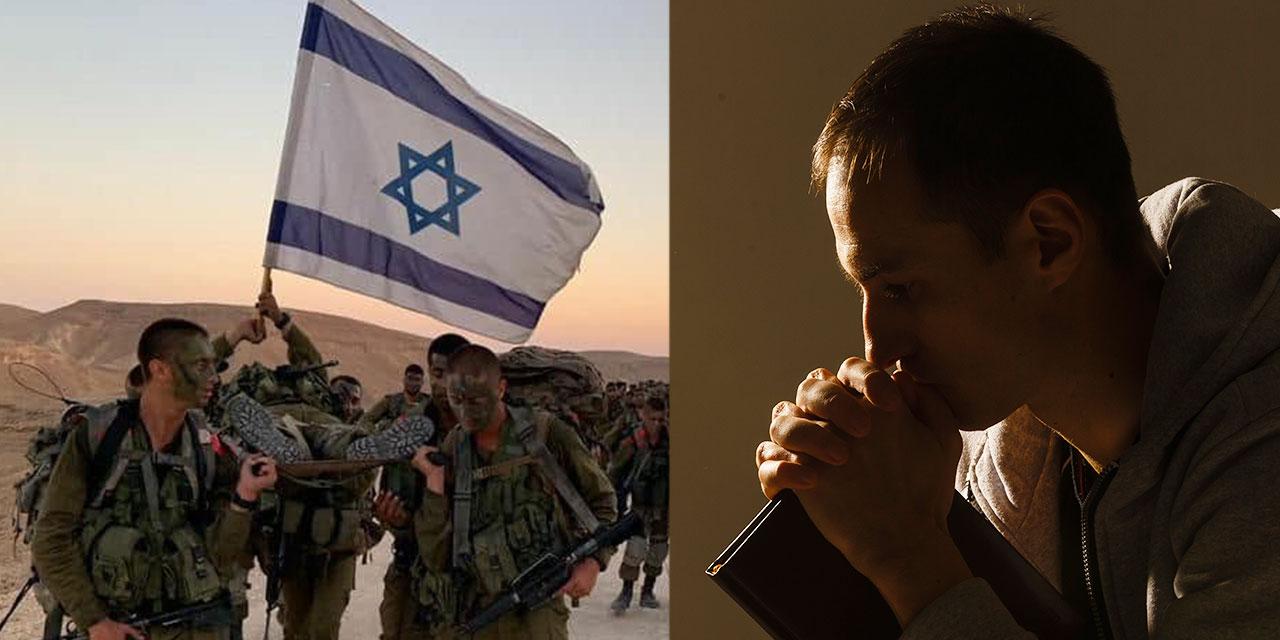
There is nothing wrong with praying for our fellow countrymen, our allies, and Israel to be successful in war. America and Israel are at war right now and we are praying for them. America is a majority Christian nation and Israel is a majority Jewish nation. Most of those going into battle are doing so with prayers to the God of Abraham, Isaac, and Jacob. They are going to battle against a regime that seeks to wipe out both Christians and Jews.
The Islamic regime of Tehran declares it wants to destroy “first the Saturday people [Jews] and then the Sunday people [Christians]”. The Ayatollah’s favourite phrases are “Death to America” and “Death to Israel”. Their radical form of Islamism views all Christians and Jews as infidels. Just because it mentions America and Israel by name does not mean the UK is exempt from this. We cannot think they will leave us alone, when in reality, we are already in a worse position against the threat of radical Islam, largely because we are not challenging these hateful ideologies at home.
Since the war began, we have also seen what we knew all along, that not only is Iran a threat to the West and Israel, but it is a threat to the entire region, as it is attacking surrounding nations (particularly aiming at civilians), as well as its own people (who mostly oppose the regime) and it is ruling over them with an iron fist.
This is a fight of good against evil, and it is the nations with majorities that serve God who are the ones facing down these threats. It is not wrong for Christians to support the downfall of the Iranian regime. In fact, we believe it is right to stand against evil. God is not neutral in this.
Sadly, the UK is no longer a Christian majority country. And the way the Labour government has acted before and during this war in regards to supporting Israel and America is a sorry reflection of that. This is why the Church must repent and get back to proclaiming the truth of the Bible with courage.
God fights for His people, but God also enables His people to fight
In the Book of Esther, we read the Purim story that teaches us about how God saved the Jewish people from destruction through Esther and Mordecai. An interesting point about this story is that God did not perform miracles in order to defeat the enemy as He did with Egypt. Instead, the story of Esther focuses on God’s people taking action, and ultimately fighting.
God clearly poured favour upon Queen Esther and Mordecai to put them into the positions they were in, where they were both wise and courageous in their diplomacy. Haman resented the Jews and was the one who cast lots and chose Purim as the day to destroy the Jews after he had tricked the King into agreeing to the massacre. However, once the King realised killing the Jews also meant killing his wife, Haman was hanged on the very gallows he had built for Mordecai. But that isn’t the end of the story. Haman was hanged, but the date of Purim was already set, and there was no way to stop the massacre through another decree. Instead, the King issued a second decree to the Jews telling them that they will be attacked on Purim, and that they had the right and duty to defend themselves.
Jews weren’t saved from the battle during Purim; they fought (and likely some died), but they overcame their enemies. Notably, the ten sons of Haman were all killed on Purim. The day they tried to avenge their father, they instead joined him in death. So God didn’t take away the fight; He equipped His people for battle. God’s people were not pacifists, and neither was God.
“Blessed be the Lord my Rock, who trains my hands for war, and my fingers for battle.” (Psalm 144:1)
We need to recognise that there is a spiritual element to all of this. There is nothing new under the sun, and as we know from the Bible the spiritual war over Persia (modern day Iran) is a significant one.
The Iranian regime seemingly knows about the significance of Purim.
Back in 2024, when they launched the first-ever direct attack at Israel from Iranian soil, they did so on the evening that Jews were celebrating Purim. The tyrants of Tehran wanted to avenge Haman, it would seem, and they thought the attack would do a lot of damage to Israel. After all, they launched hundreds of missiles and drones at Israel in order to do “maximum damage”.
The attack was a complete failure for Iran and a success for Israel and her allies, including the UK and USA, who shot down 99% of the projectiles fired at Israel. There was sadly one casualty on the ground, as a Palestinian man was killed by falling shrapnel from an Iranian missile.
Fast forward two years to Purim 2026, and again war began against Iran with Israel and US forces assassinating Ayatollah Ali Khamenei, just days before Purim.
Note that Haman was killed before Purim, and then it was on Purim that the Jewish people defended themselves from those who sought their destruction. Likewise, in 2026, Israel took out Khamenei and is now fighting against those who seek their destruction, including Iran’s IRGC and Hezbollah terrorists in Lebanon.
Remarkably, there was also a blood moon on Purim in 2026 (and a partial one in Purim in 2024), which is a rare occurrence. We are told in Scripture that the sun, moon, and stars are appointed “for signs,” (Genesis 1:14). And also Jesus Himself talks of the celestial ordinances in this manner: “There will be signs in sun and moon and stars, and on the earth dismay among nations,” (Luke 21:25).
The next blood moon, or total lunar eclipse, takes place in December 2028. Purim’s total lunar eclipses are far rarer than other Jewish feast days. So, for a war against the ancient Persian threat to occur on both Purim and during a blood moon seems more than just a coincidence.
Therefore, we do not believe that God is neutral in this war. Likewise, we don’t believe this war is about the foolishness of men, as many are depicting it to be, or some attempt to obtain more oil, or a deflection from political problems at home. This is a war against a regime that seeks the destruction of God’s people. This is a battle of good against evil.
We are not involved physically, but as Christian Watchmen, we must be involved spiritually.
We are praying for the protection of all civilians in the region, including in Iran. We are praying for Israeli and American forces to have success in battle. We are praying that good will overcome evil, including politically, and here at home in the UK. And we pray for peace.
May God defend and fight for His people!