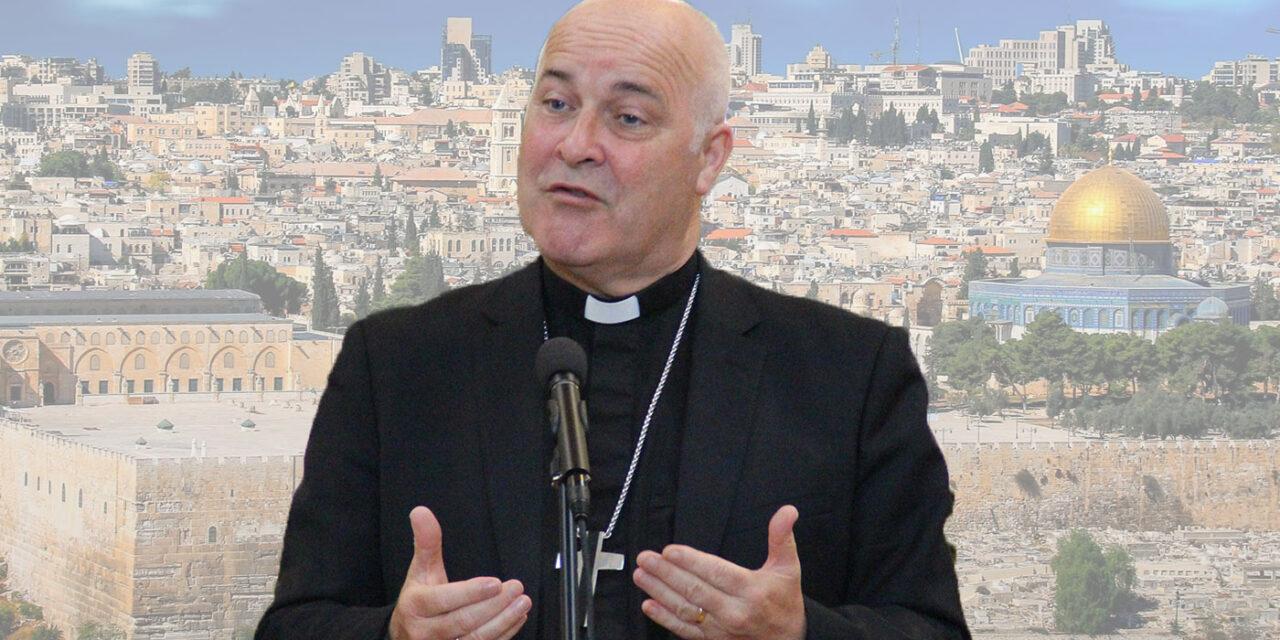
Recent remarks by the Archbishop of York, Stephen Cottrell, are extremely troubling and should be a concern to both the Jewish community and the many Christians who stand with Israel.
In an interview with the Church Times, the Archbishop claimed that Israel had committed “genocidal acts”, and described the situation in the West Bank as “apartheid” and “ethnic cleansing”. These are extremely serious accusations, and for a senior figure within the Church of England to make them is deeply regrettable.
The response from Jewish leaders was immediate. The UK’s Chief Rabbi, Sir Ephraim Mirvis, described the Archbishop’s words as “irresponsible” and warned that such language only fuels further division. The Board of Deputies also expressed concern and sought clarification from his office. These reactions are understandable. Words like “genocide” and “apartheid” are not simply political labels; they carry historical and moral weight. Using them inaccurately does real harm.
What is troubling is that the applause for the Archbishop’s comments has come not from those seeking peace, understanding, or reconciliation, but from groups that have long opposed Israel’s very existence. For example, the Muslim Council of Britain hailed his remarks as a “ray of light” and said that “as British Muslims we stand in solidarity with him.”
Just think about that for a moment. When those who routinely reject Israel’s very existence cheer a Christian leader’s statements on Israel, it should set off alarm bells.
Israel is not only an ally of the UK, but it is the nation that God established and that God brought back from exile as documented in the pages of Scripture. God loves Israel, and as Christians we should have a heart for the things God loves.
As God declared to Abraham, “I will bless those who bless you, and I will curse him who curses you…” (Genesis 12:3 NKJV). This foundational promise still shapes how Christians view Israel today.
Israel isn’t perfect, just like every other nation on earth, but accusations of genocide and apartheid do not align with the facts. Israel is the Middle East’s only democracy, home to Jewish, Muslim, Christian, and Druze citizens who can vote, serve in parliament, study in universities, and contribute to public life. And repeated polling of Israel’s Arab population shows the majority are proudly Israeli. Why would the majority prefer living under Israel if they were living “under apartheid”. The truth is that Israel is NOT apartheid.
Likewise, security restrictions in Judea and Samaria (the West Bank) exist because of a long and painful history of Palestinian terrorism. This is a context that should not be ignored by anyone speaking on the subject, especially someone in church leadership.
Archbishop Cottrell’s remarks followed a brief four-day visit to the region. He recounted moments where he encountered angry “settlers”. And while it is true that a tiny percentage of Israeli settlers have caused trouble, it should be noted that he was alongside an activist group that has been involved in provocative activities in the past, and often confronts Israeli security. It appears Israeli security personnel asked him to leave dangerous areas for his own safety. Rather than recognising these measures as protective, he interpreted them as evidence of oppression. This conclusion overlooks the complex and often volatile realities on the ground, and reduces a difficult security situation to a simple accusation of wrongdoing by one side alone.
Scripture calls believers to a far different posture. We are to “pray for the peace of Jerusalem” (Psalm 122:6), approaching Israel with prayerful concern rather than simplistic accusations is a far wiser strategy.
In recent months, parts of the Church of England have adopted increasingly critical language about Israel. While raising humanitarian concerns is entirely legitimate, crossing into language that mirrors that of anti-Israel campaigners is unhelpful and damaging. The Church has a responsibility to be fair, careful, and informed, particularly on matters that affect Jewish safety and Christian-Jewish relations in the UK. And as we often say, what starts in Israel never stays in Israel. Jews in the UK are increasingly under threat because of the lies being spread against Israel.
It is also important to note a wider trend. Only days before making these comments, the Archbishop participated in a “Gaia” environmental event. He used the opportunity to pray for “Gaia”, which is the Greek Goddess of Earth, and he spoke about asking forgiveness for the way in which humans have treated Earth, and for us to be better at helping fight “climate injustice”. He completely neglected praying for God’s Will to be done, or for the spread of the Gospel over the earth. It was all climate change focused.
This is not to diminish the importance of caring for creation, but it does highlight how the established Church is largely speaking the language of the world and conforming to it. Christian leaders should be grounded first and foremost in Scripture and the message of hope in Christ. When this foundation is diluted, it becomes easier to adopt popular narratives, such as fighting for the world’s distorted viewpoint of ‘justice’ instead of God’s righteous justice.
Christians who hold to a biblical understanding of Israel recognise that this issue is not simply political. The Scriptures speak clearly of God’s enduring covenant with the Jewish people and His purposes for the land of Israel. This does not mean endorsing every government decision, but it does mean approaching Israel with fairness, understanding, and a recognition of its unique place in God’s plan.
“And I will establish My covenant between Me and you and your descendants after you… for an everlasting covenant… Also I give to you and your descendants after you the land… as an everlasting possession; and I will be their God.” (Genesis 17:7–8)
Israel faces immense challenges, including threats from terrorist organisations and pressure from the international community. In such a climate, the Church should be a voice of clarity and balance — not one that unintentionally amplifies hostility.
We hope the Archbishop will reconsider his wording and engage more deeply with the complexities of the situation. Next time he visits Israel, we encourage him to meet with popular Jewish leaders rather than a fringe minority that sides with Palestinian nationalism. We encourage him to meet with Christian Zionists, many of whom are in the Arab community, who put Scripture at the forefront of their beliefs and recognise Israel’s God-given claim to the land, instead of only meeting those who believe in Replacement Theology and claim that Jesus was a “Palestinian”. We encourage him to look at this conflict from Israel’s side, and not just the Palestinians side. But, unfortunately, we suspect it might be that he is talking to those who are like-minded to himself. And that is the biggest concern.
More importantly, we encourage Christians across the UK to continue standing with Israel in prayer, in truth, and in the spirit of the biblical call to bless the Jewish people. Pray for the Archbishop, that God will open his eyes to the truth of Israel. And pray that CUFI will impact the Church in Britain, including the Anglican Church, with the truth of God’s Word.