-
Antisemitic violence surged across Europe this summer, with Jews hunted, harassed, and attacked outside synagogues, on beaches, in taxis, and on holiday, simply for being Jewish.
-
Many of these attacks were accompanied by pro-Palestinian slogans, revealing the dangerous overlap between anti-Israel rhetoric and anti-Jewish attacks. The spike of antisemitic incidents in the UK coincided with the controversy at Glastonbury.
-
Despite this alarming trend, Western governments are moving to recognise a Palestinian state, often without conditions on Hamas or considerations for Jewish safety, risking further legitimisation of terrorism and antisemitic hate.
What starts in Israel doesn’t end in Israel. Antisemitism has been at record highs since October 7th 2023, and this summer was no exception.
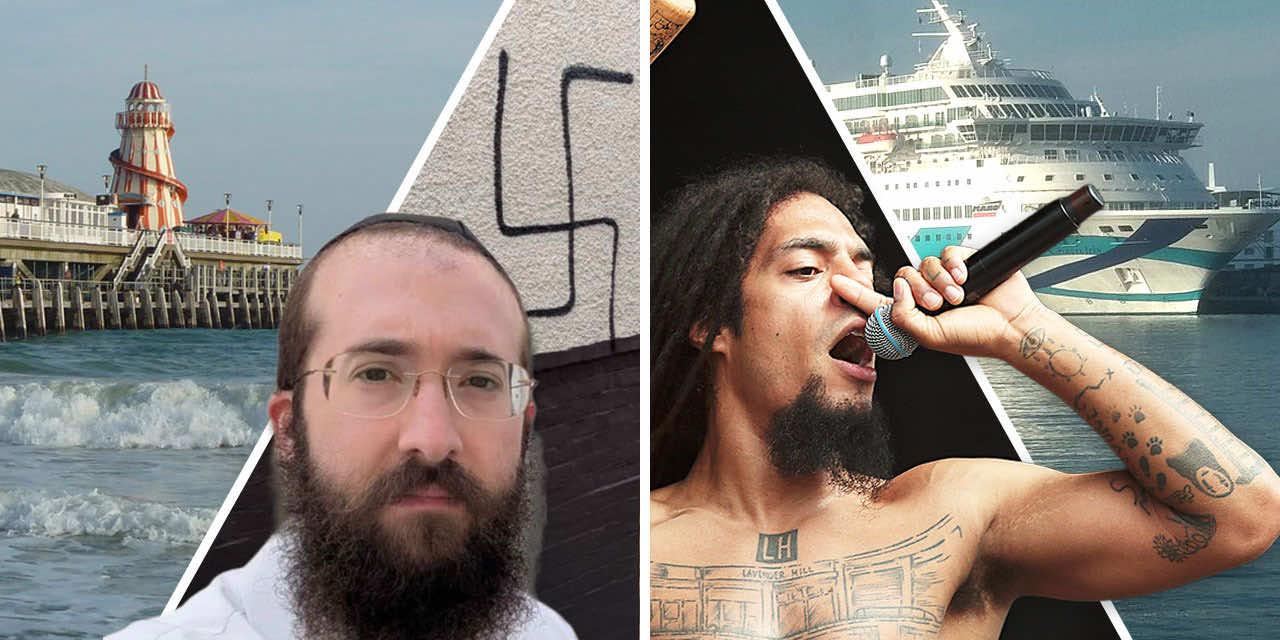
Over the UK Bank Holiday weekend, a Jewish teenage boy was shot in the head with an air rifle in the English seaside city of Bournemouth. The antisemitic attack took place outside a synagogue on 23 August. The boy, who was wearing a kippah, has been released from hospital.
Also in Bournemouth, the rabbi’s home was daubed with a swastika. Rabbi Benzion Alperowitz posted a video of him beside the swastika, saying: “Our kids were a little afraid as they saw our shock, but we took the opportunity to speak to them about Hashem who runs the world and how we are always in his hands. They seemed to be reassured by that, and I heard my daughter telling other children in Shul how Hashem is always watching over us, so there’s no reason to be afraid.”
Anti-Jewish attacks throughout Europe
Over the same Bank Holiday weekend as the antisemitism in Bournemouth, anti-Jewish attacks took place across multiple countries. In France, Jewish-owned cars in the city of Châtel were defaced with “Free Palestine” graffiti. In Vienna, Austria, a Jewish family was kicked out of a taxi by the driver who assaulted one of the passengers and hurled antisemitic slurs, calling them “murderers”. In The Netherlands, Israeli tourists were secretly filmed at a holiday resort, with the footage shared online to encourage targeting. On the Italian island of Sicily, a hotel employee urged an Israeli guest to cancel her booking if she supported the Israeli government’s actions in Gaza. In Frankfurt, Germany, three Jewish activists were attacked whilst hanging posters of the Israeli hostages during a vigil in a park. A group of twenty to thirty people, some masked, hurled antisemitic abuse and poured red paint on pictures of the remaining hostages. This all happened over one summer weekend.
It is unlikely you will have seen or heard these incidents reported in the media. But antisemitism is running rife throughout Europe.
There has also been a surge in antisemitic incidents in southeast Europe this summer, with a 133% increase during one week in July. For example, an Israeli tourist in Greece had his ear bitten off in an antisemitic attack at a beach bar near Athens. A man, a Syrian migrant, shouted “Free Palestine” and “I am Hamas” at the Jewish group before being thrown out by security. The attacker then returned and committed the awful attack.
The incident is part of a disturbing pattern. Just days earlier, Israeli teenagers were assaulted by Turkish tourists on the island of Rhodes. A group of around 30 to 40 people, armed with knives, chased the group after one of them asked if they were Israeli.
The day before, also in Greece, an Israeli-owned cruise ship was prevented from docking at the Greek island of Syros due to a large pro-Palestinian protest taking place at the port. The protesters clashed with police, and the ship carrying 1,700 Israeli passengers had to be re-routed to Cyprus. The same ship was met with pro-Palestinian protesters a few days later in Crete, and the Israeli passengers had to disembark under police protection.
Sadly, we could continue to list more antisemitic incidents that occurred throughout the summer of 2025. Such as in Lucerne, Switzerland, in July where 10 Jewish students were asked by a man at the train station if they were Jewish. He then pulled out a knife and shouted “Death to Jews”. In Venice on 13 August, a Jewish couple visiting as tourists were harassed by three men before being spat on and had a dog set on them. The husband and his wife, who was five months pregnant at the time, fled to a nearby kosher restaurant. In Milan, a French Jewish man and his 6-year-old son were attacked at a rest stop after being recognised as being Jewish. The father was punched and kicked as the attacker shouted “Free Palestine” and “genocide”. Also in Milan, dozens of posters and stickers were placed outside kosher restaurants, near synagogues, and in Jewish residential areas, with messages like “Israelis not welcome” and “Boycott Israel”.
Anti-Israel rhetoric is fuelling anti-Jewish hate
These antisemitic attacks are not happening in isolation. It is clear that the hateful lies and antisemitic slurs levelled at Israel have a direct correlation to the attacks on Jews. Almost all of the above examples are accompanied by the verbal assaults “Free Palestine”, “Genocide”, and other pro-Palestinian slogans. This is not insignificant. The false claims of “starvation” and “genocide” carried by much of the media and many politicians are adding fuel to antisemitism.
According to CST, the UK group that monitors antisemitic incidents, the most intense single day this summer was 29 June, when 26 antisemitic incidents were recorded – the day that Bob Vylan chanted “Death, Death to the IDF” from the Glastonbury stage, which was broadcast by the BBC. No one disturbed by Bob Vylan’s antisemitism believed that it would stay on the Glastonbury stage; it should serve as a sharp reminder that every lie spread by Hamas and those who support them must be challenged. Not speaking up and defending the truth is failing to protect the Jewish community globally.
The impact of recognising a Palestinian state
It has also been a summer where the UK, Belgium, France, Canada and Australia have either recognised a Palestinian state, or committed to do so. In the case of France, it says it will do so unconditionally. Belgium said it was conditional on the hostages being released, and would coincide with imposing 12 sanctions on Israel. Meanwhile, the UK has said it will recognise a Palestinian state without any conditions placed on Hamas. In the case of Belgium, they are using the hostages as bargaining chips. In the case of the UK, the hostages are not even part of the proposal. Either way, these approaches are rewarding Hamas terrorism whilst at the same time punishing Israel. The more politicians push this narrative, the more they will fail to protect the Jewish community.
The summer of antisemitism seen in the UK and Europe can only be confronted if we stand with Israel in their winter struggle. We cannot tackle Jew-hatred if we do not speak out against the hatred towards Israel. At Christians United for Israel UK, we will not be silent.