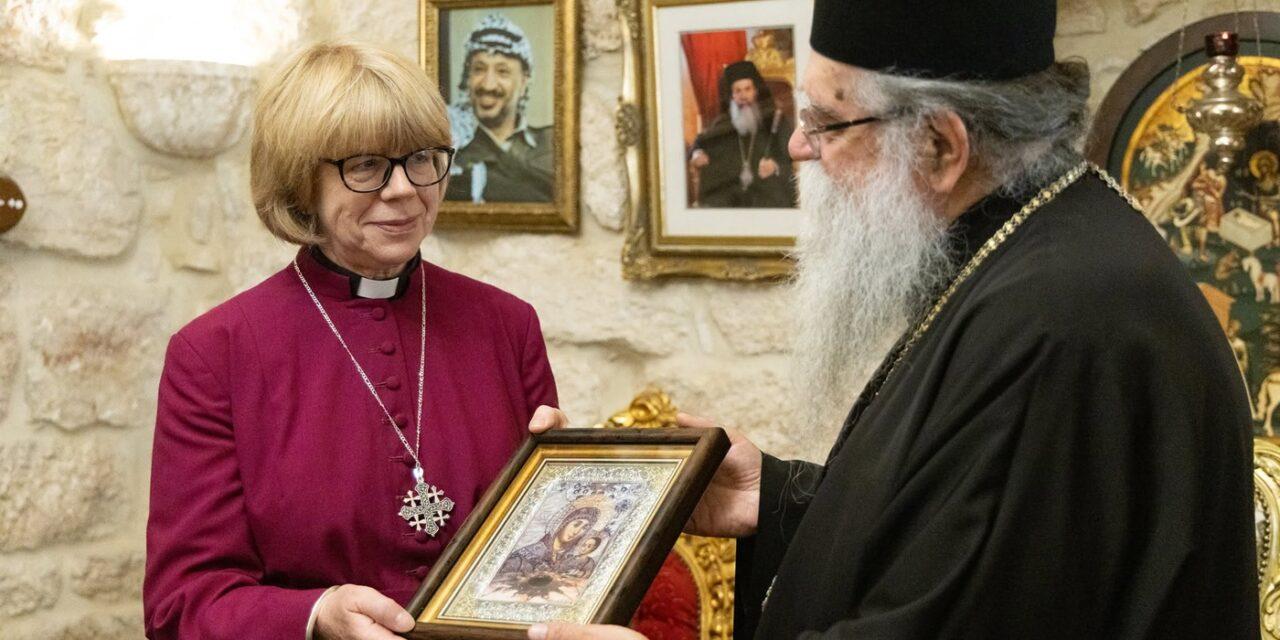
- Archbishop Sarah Mullally’s pilgrimage to the “Holy Land” appeared to overlook the Jewish people’s Biblical, historical and present-day connection to the Land.
- The Archbishop rightly showed concern for Palestinian Christians, but calling for an end to “the occupation”, insisting on a two-state solution, and affirming Islamic control over the Temple Mount and other Jewish holy sites is a political message that only serves the Palestinian liberation narrative against Israel.
- Christians should pray for Palestinian believers, but the Church must not embrace a theology that erases Israel, sanitises Palestinian extremism, or presents the Jewish state as the obstacle to peace.
- A Holy Land without Israel is not the Holy Land of the Bible.
The Archbishop of Canterbury has just completed a five-day pilgrimage to the Holy Land, which she described as a solidarity visit with Palestinian Christians. “The Churches of this holy city are custodians of a living Christian presence in the very place where the foundations of our faith were laid,” Archbishop Sarah Mullally posted on social media after visiting the Church of the Holy Sepulchre in Jerusalem. One can understand her point in this context – Christianity was birthed in Jerusalem and spread throughout the world – but the foundations of our faith cannot be fully understood without recognising its Jewish roots and the Jewish inheritance of the Land.
And that is what was glaringly absent from her tour. Reported accounts of her pilgrimage make no mention of a single visit to a Jewish holy site.
Instead, a published “pastoral letter” written by Archbishop Mullally, jointly with the Anglican Archbishop in Jerusalem, Hosam Naoum, at the end of her visit, speaks of “occupation”, a two-state solution, a shared capital, and the “Hashemite custodianship” of the Jerusalem holy sites.
“In light of the International Court of Justice’s Advisory Opinion of 2024, we urge you to advocate with political representatives to take all necessary measures to establish a credible path towards ending the occupation,” the letter stated.
Admittedly, she was invited by Palestinian Anglicans. What we do know is that Archbishop Mullally visited St George’s Anglican Cathedral and College in East Jerusalem and a number of Palestinian healthcare charities. She met various Palestinian Christian leaders and visited St Peter’s Anglican Church and Bethlehem’s Church of the Nativity in the West Bank, known Biblically as Judea and Samaria.
There were very few Biblical sites visited outside of the Palestinian territories. The exception was Nazareth, a city in Israel, where she prayed at “St Mary’s Well” and also visited the Grotto of the Annunciation. There was no confirmed record of her visiting the Western Wall, the Temple Mount area, the City of David, the Mount of Olives, the Sea of Galilee, or other Israeli sites such as Yad Vashem, or sites pertaining to the October 7th massacres, for example. A missed opportunity indeed.
However, did Sarah Mullally meet Jewish leaders? She met members of Rabbis for Human Rights, a group that accuses Israel of “occupation”, together with the Sabeel Ecumenical Liberation Theology Center at St George’s College. The Archbishop lauded their work as being “across faith communities for human rights, justice and peace in Israel and Palestine”.
It is worth pointing out the “Palestinian Liberation Theology” that is behind Sabeel. Its website explaining its history defines Jesus as “a Palestinian Jew who lived under Roman occupation.” It continues, “Rather than stressing the full divinity of Christ, Palestinian liberation theology emphasized Christ’s full human nature. In doing so, 20th century Palestinian Christians were able to connect with their 1st century ancestors and relate to Jesus in his relationship to the land, people, and empire.”
The website continues to accuse Zionism of using “exodus and promised land motifs” to “displace Palestinians”.
This bad theology is part of the wider problem. For decades, it has been used to demonise Israel and present Palestinians as victims.
Christians throughout the Middle East need our prayers, including those living in the Palestinian territories. But Archbishop Mullally could have also met with Arab Christians living in Israel; she could have met Messianic believers. She could have encouraged Gentile Christians representing every tribe and tongue who live in freedom in Israel – the safest place for Christians in the Middle East.
If Jewish leaders were meaningfully included in the visit, that should have been made clear. The silence itself is telling, especially in a pilgrimage that repeatedly invoked the “Holy Land” while appearing to omit the Jewish people’s central place in it.
This would have been important not in the context of interfaith dialogue, but because the Holy Land is the ancestral, Biblical and historic land of the Jewish people. As Christians, we owe a debt of gratitude to the Jewish people. Also, if the Archbishop of Canterbury desires to stand with UK Jews against antisemitism, there is equal merit in standing with Jews in Israel against antisemitism also.
Yes, Palestinian Christians are living with hardship. But Sarah Mullally needs to be careful not to embrace the heavily politicised, anti-Israel driven, Palestinian victimhood narrative that portrays them as targeted victims of Israeli occupation. Doing so blatantly ignores the repeated refusals by the Palestinian leadership to accept peace, fails to condemn the anti-Christian and anti-Jewish hatred promoted by Islamist ideology, and ignores the desire to wipe out Jews from the Land of Israel. Not acknowledging this makes it more difficult to combat the terrorism perpetrated by Palestinian terror groups, such as Hamas, which is responsible for prolonging the conflict and oppressing Christians in the region.
This does not mean that Archbishop Mullally is wrong to meet and hear the grievances of Palestinian families. But legal disputes over farmland, for example, which she heard with empathy, are not a sound basis from which to give advice on international law, especially when Israel’s legal case is completely ignored. For example, the Archbishop met and heard the Nasser family explain their long legal struggle over ownership of their land; yet the public framing of the visit gave no indication that Israel’s legal arguments regarding land registration, planning disputes, or wider security concerns were seriously considered.
Another example was her meeting with Layan Nasir, a 26-year-old Palestinian Christian woman and university student. Layan was recently released from prison in Israel after a cycle of imprisonments and detentions. Her incarceration resulted in widespread campaigning among Anglican church leaders. She was alleged to have been participating in and affiliating with the Democratic Progressive Student Pole (DPSP). The DPSP is a left-wing Palestinian student organisation that Israel proscribed and designated as an “unlawful association” under a military order issued in August 2020. Israel officially designates the DPSP as the direct campus student wing of the Popular Front for the Liberation of Palestine (PFLP). The PFLP is a Marxist-Leninist faction designated as a terrorist organisation by Israel, the United States, and the European Union. According to the Israeli military, the DPSP functions as a pipeline used by the PFLP for “recruiting young men and women to commit acts of terrorism” and building organisational infrastructure under the guise of university politics.
It is not for us to determine whether the allegations are true but let us be very clear: Layan Nasir was not arrested for being a Palestinian Christian. She was arrested for allegedly being associated with a proscribed terror group.
The Holy Land cannot be understood by removing Israel from the picture. A Christian pilgrimage that speaks of Jerusalem, Bethlehem and Nazareth while failing to acknowledge the Jewish people’s Biblical, historical and present-day connection to the Land risks presenting a distorted view that serves the Palestinian liberation narrative rather than Biblical truth. The Church should pray for Palestinian Christians, but it must not do so by embracing a theology that erases Israel, sanitises Palestinian extremism, or treats the Jewish state as the obstacle to peace. A Holy Land without Israel is not the Holy Land of the Bible.