
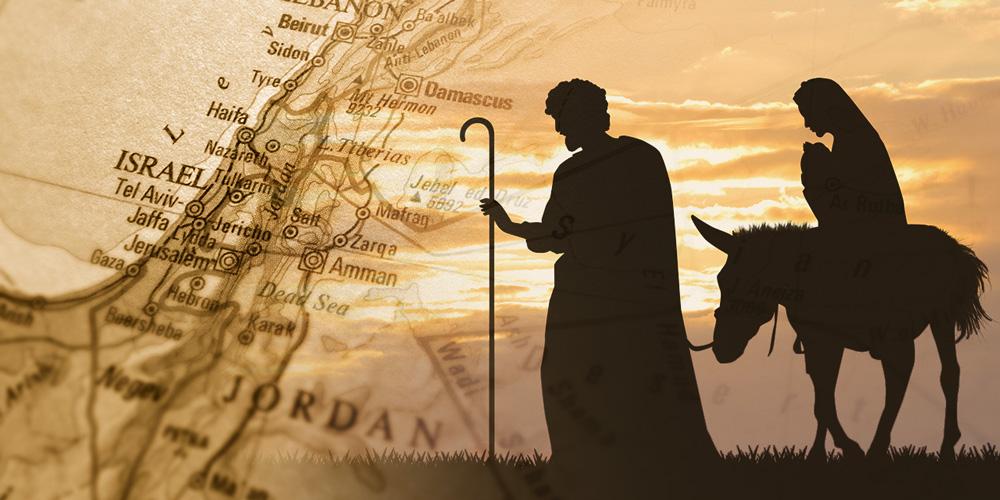
Jesus was not a Palestinian refugee. But this claim by pro-Palestinian groups is becoming increasingly popular, and many Christians have adopted this false narrative. In this article, we explain why it matters and how to challenge it.
Jesus was not a Palestinian
Let us begin with Jesus’s Jewish identity. Jesus came for all people, of course, but His Jewish identity matters. Jesus was born in Judea to Jewish parents in the town of David. Jesus lived as a Jew, died as a Jew and is returning as the Lion of Judah. Describing Jesus as a Palestinian is becoming increasingly common practice in churches that teach that the Church has replaced Israel, because Replacement Theology always undermines Jesus’s Jewishness. This almost always leads to pro-Palestinian bias against Israel taking root.
The smear that Jesus was a Palestinian can be countered historically and Biblically. Beginning with historical accuracy, there was no such place called Palestine before Jesus was born, when he was born or for his entire life. It was in the second century that the Romans renamed Judea, ‘Syria Palaestina’ after the Jewish revolt of 135 AD. They did this as a political punishment for the Jews after the failed revolt, in an antisemitic attempt to erase Jewish identity and connection to the land of Israel, which is no coincidence considering that this is the same motive behind those insisting Jesus was Palestinian. In ancient Israel, the word ‘Philistia’ (Hebrew: Peleshet) or ‘Palaistina’ (Latin) referred to the coastal Philistine cities, not the Jewish highlands, or Judea. The Philistines were Israel’s enemy and the Bible says that they would be destroyed as a people group. The Philistines were not Arabs, or Muslims, or related to modern Palestinians. In other words, the Romans renamed Judea after Israel’s enemies, to spite the Jewish people.
The word ‘Palestine’ has, of course, been used in the region for centuries, including the Mandate of Palestine. But it is very unusual to denote an identity to a historical figure that was not used in their lifetime. The word ‘Palestinian’ today speaks of Arabs living in the Palestinian territories. But at the time Jesus was on earth, Arabs did not live in the Land of Israel. They lived primarily in Arabia (and Islam was introduced 600 years later).
The wrong belief that Jesus was a Palestinian can most importantly be countered Biblically. Here are some key references in the Bible that remind us that Jesus was a Jew, living in Judea, born in a Jewish town to Jewish parents and lived life as a Jew. This is important, not simply to understand His ethnicity, but to understand the fulfilment of His coming and what He means to us as Christians.
Jesus is the Lion of the tribe of Judah. (Rev 5:5)
He was born in the ‘City of David’, the Jewish town of Bethlehem, the ‘breadbasket’ of Judea. (Luk 2:11)
He was of the lineage of King David. (Luke 2:4)
He was circumcised on the eight day. (Luke 2:21)
He was presented at the Temple in Jerusalem after 40 days. (Luke 2:22)
Simeon and Anna recognised Jesus as the One sent to bring redemption to Israel. (Luke 2)
The wise men from the east, from elsewhere in the Middle East, acknowledged him as “the one born King of the Jews”. (Matt 2:2)
His parents escaped with Jesus to Egypt, but returned back “to the land Israel”. (Matt 2:21)
He lived in Nazareth, a Jewish town, and was known as ‘Jesus of Nazareth’.
He followed the Jewish custom of learning his father’s trade.
He called the Jewish temple “my Father’s house”. (John 2:16)
He taught, kept and respected the law of Moses.
He taught in synagogues.
He celebrated all the Jewish feasts, including Passover. (Matt 26:17)
He celebrated Hanukkah. (John 10:22)
He recited the Shema “‘Hear, O Israel, the Lord our God, the Lord is one. And you shall love the Lord your God with all your heart, with all your soul, with all your mind, and with all your strength.’ This is the first commandment.” (Mark 12:29-30)
His disciples frequently addressed him as ‘Rabbi’. (John 1:38, John 4:31)
Nathanael called Jesus “Rabbi, you are the Son of God; you are the king of Israel.” (John 1:49)
Jesus said he was sent to the lost sheep of Israel. (Matt 15:24)
He referred to the land as either Judea or Israel.
He prayed to the God of Abraham, Isaac and Jacob.
He was put on trial as a Jew.
Those mocking Jesus called him the King of the Jews and placed the sign on the Cross. (Mark 15)
In Acts, Peter said, “From this man’s seed [King David], according to the promise, God raised up for Israel a Saviour—Jesus.” (Acts 13:23)
His disciples asked Him “When will you return the kingdom to Israel?” (Acts 1:6)
He promised to return to Israel.
The motivation behind Palestinian narrative
Christians who describe Jesus as a Palestinian have bought into an antisemitic campaign against Israel. Known as Palestinian Liberation Theology, it misappropriates Jesus as a Palestinian in a hostile attempt to demonise Israel, using terms like Jesus living ‘under occupation’ in an effort to accuse Israel of mistreating Palestinians. Palestinian Muslim leaders, who have no authority whatsoever to teach Christians, know that by denying the Jewishness of Jesus they can further undermine the Jewish connection to the Land of Israel and separate Jesus from the people of Israel. It tries to redefine Jesus as a political freedom fighter who stands against Israel. This deception is rampant in pro-Palestinian advocacy, but is also misleading many others. Sadly, it risks separating Christians further away from the Jewish identity of our faith and creating a further chasm between Christians and Jews.
Jesus was not a refugee
This year, there is another aspect that is misleading Christians. This is the claim that Jesus was a refugee. Again, it is a politicised attempt to impose the story of Jesus’s birth onto a contemporary debate about immigration. This kind of politicisation of the Christmas story is morally wrong, it holds no equivalence, but it is also historically inaccurate.
To those who believe the lie that Jesus was a Palestinian, the thought that he was also a refugee creates the perfect analogy. They contend that not only was Jesus “born in Palestine” but he was forced to flee and became a refugee, just like many Palestinians.
Historically speaking, Jesus’s family did find refuge in Egypt. The Bible explains that due to King Herod’s plan to search for Jesus in Bethlehem, the angel of the Lord appears to Joseph in a dream and was instructed to take Jesus and his mother Mary and escape to Egypt immediately until the Lord told him (Matthew 2:13-15). At the time, Egypt and Judea were both part of the Roman Empire, so Jesus’s family were not there illegally, or with refugee status, or as an ‘asylum seeker’ or any other term that doesn’t really apply except to those motivated to make an unrelated political charge. Egypt, however, was not under the jurisdiction of Herod, and therefore was a safe haven for the young family. Egypt and Judea were linked by a coastal road known as the Via Maris (Way of the Sea). There was a large Jewish community there, with settlements dating back to the time of Jeremiah. The Jews there had their own synagogues, spoke Greek, and the first translation of the Septuagint was made in the third century BC in Alexandria, originally for the Greek-speaking Jews there.
In Egypt, an angel appeared to Joseph again, telling him to return to Israel as Herod was now dead. The Bible explains that Jesus’s return to Israel from Egypt was in fulfilment of prophecy: “that it might be fulfilled which was spoken by the Lord through the prophet, saying, ‘Out of Egypt I called My Son.’” (Matthew 2:15).
The problem with the ‘refugee’ narrative is that some have made it central to the Gospel message. Jesus didn’t come to earth to be a refugee, despite the historical and prophetic significance of the escape to Egypt. Jesus came to earth as ‘Immanuel’ – God with us. But for some churches this year, the focus of the Christmas message is that he was a refugee, and are carelessly associating it with current migration issues in the West.
Denying Jesus’s identity can harden hearts
Even Jesus Himself asked His disciples who they say He is. This is the most important question. Peter answered with honesty and sincerity, but most importantly with revelation of who Jesus was and why He came. “He said to them, ‘But who do you say that I am?’ Simon Peter answered and said, ‘You are the Christ, the Son of the living God.’”
In response to Peter’s answer, Jesus made a wonderful promise about the future of the Church: “And I also say to you that you are Peter, and on this rock I will build My church, and the gates of Hades shall not prevail against it.”
Every Christian should know that what matters most is understanding who Jesus really is. It is important to realise that God took the form of a man for the sins of the world. He is Saviour to all who believe, irrespective of nationality or ethnicity. But denying Jesus’s Jewish identity could be detrimental to our full understanding of who Jesus is and why he came. Furthermore, deliberatly embracing the narrative that Jesus was Palestinian is a seed that is likely to harden our hearts towards the Jewish people, damage our worldview towards Israel, and is also likely to hinder us from having a full revelation of the gospel of Jesus Christ. We should take note of Jesus’s response to Peter – the church would be built on a true revelation of who He is.