- Ireland has withdrawn from Eurovision after decision made to allow Israel
- Dublin City Council discussing renaming Park that was named after Israeli president born and raised in Ireland
- Irish leaders in Dublin report rise of antisemitism linked to hostilities towards Israel
The Republic of Ireland’s decision to boycott the Eurovision Song Contest is sadly unsurprising after threatening to do so unless Israel was kicked out. The organisers made the correct decision this week in permitting Israel to enter in 2026 – but it’s not the result that an increasingly anti-Israel Irish government wanted; the Irish RTE broadcaster shamefully join Spain, The Netherlands, and Slovenia in boycotting the competition.
irish
Ireland’s attitude towards Israel is so engrained, it makes no difference that there is now a ceasefire, or that Hamas started the two-year war by invading Israel, or that their claims against Israel are based on Hamas’s antisemitic propaganda. History has shown the dangers of boycotts fuelled by the relentless propaganda. It was Jews who became the victims through boycotts in the 1930s, and it is Jews who are the real victims of hatred against Israel today.
Jewish leaders in Dublin are reporting that hatred toward Jews and toward Israel has reached levels unseen in modern Irish history.
It comes amid a volatile campaign to rename Herzog Park in Dublin. Pro-Palestinian lobbyists wanted it to be renamed ‘Gaza Park’ or ‘Palestine Park’, and unbelievably the Dublin City Council has taken their request seriously.
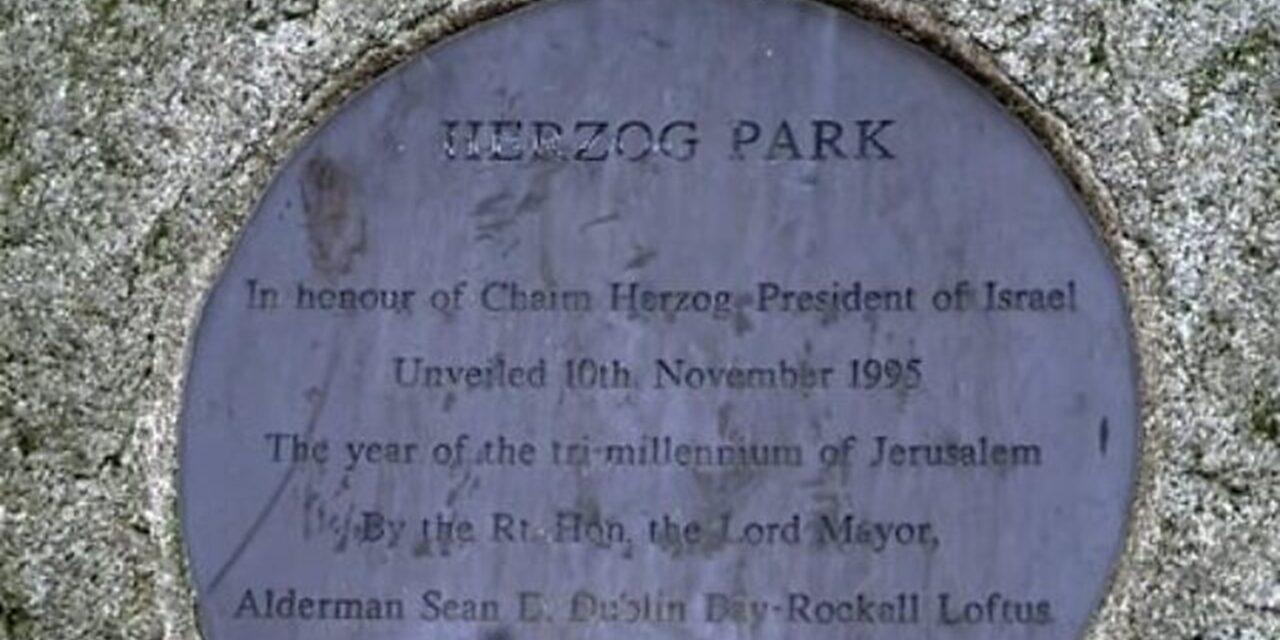
Herzog Park was named in 1995 in honour of Chaim Herzog, Israel’s sixth president from 1983 to 1993, who was born in Belfast and raised in Dublin. His father was Dublin’s chief rabbi, who became the first chief rabbi of Israel. Chaim Herzog’s son, Isaac, is Israel’s current president.
The park is located in the heart of Dublin’s small Jewish community. Morris Cohen, president of the Jewish community in Ireland, said the attempt to strip the park of its name amounted to an erasure of Irish Jewish heritage. “This wouldn’t be done to any other small community in Ireland,” he said. “Not to people of colour, not to the Traveller community, not to the LGBTQ community. We feel extremely aggrieved. Herzog is a child of the community. He lived here, went to school minutes from the park. This is our history.”
Shockingly, the proposal was agreed by the council’s commemorations committee last July, with only one objection, to recommend to the full council the removal of the Herzog name from the park. It also agreed a consultation process be undertaken to determine an appropriate new name. The recommendations were to be put to councillors on Monday night for approval before an intervention by council chief executive Richard Shakespeare on Sunday evening.
He said he was proposing to withdraw the item from Monday’s agenda and refer it back to the commemorations committee, because the correct legislative procedures had not been followed.
Even though the decision has been stalled for now, the matter is not over.
Oliver Sears, founder of the Holocaust Awareness organization, joined in describing to Ynet how stunned they were watching the council meeting. According to Sears, some councillors openly questioned Israel’s right to exist — something defined as antisemitism under the IHRA definition. “It was extraordinary,” he said. “A very low point here in Ireland.”
Both leaders said the Herzog Park episode has become symbolic of a much larger question: whether Ireland’s Jewish minority will continue to feel safe and protected in a country where it has lived for more than a century. “The past two years have changed everything,” Sears said. “We are witnessing a shift that few of us ever imagined possible.”
Asked whether rising hostility could push Irish Jews to emigrate, Cohen said the community has not reached that stage “thankfully,” but added: “We have to be cognizant of history. We need to be careful not to miss the signs.” While physical attacks have been few — “two or three incidents,” he said — the trend is deeply worrying, especially on university campuses, in schools and in the health system. Cohen said there have already been “egregious incidents” in which Jewish patients were treated offensively in hospitals.
Cohen added a final warning: “This is a time to stand up, not to look away. We will continue the fight against antisemitism. But we need Ireland’s leaders to act — not just speak.”
Ireland’s Taoiseach calls proposal ‘antisemitic’
The Council’s deliberations did at least receive a condemnation from Ireland’s leader Micheál Martin. The Taoiseach said on Sunday that the proposal to rename Herzog Park “should be withdrawn in its entirety and not proceeded with”.
Mr Martin said: “The proposal would erase the distinctive and rich contribution to Irish life of the Jewish communities over many decades, including actual participation in the Irish War of Independence and the emerging State.” He said the move is “a denial of our history and will without any doubt be seen as anti-Semitic,” adding: “It is overtly divisive and wrong.”
Israel’s response
In Israel, President Isaac Herzog’s office said it was concerned by any attempt to harm his father’s legacy and the historic ties between Ireland and the Jewish people. Mike Herzog, a former Israeli ambassador to the United States and grandson of Chaim Herzog, said the move was not a private family matter but part of a broader effort to delegitimize Israel and undermine Irish Jewish heritage.
For now, the park’s name remains unchanged, but the council’s planned consultation suggests the issue could return to the agenda after further review.
Ireland’s Chief Rabbi Yoni Wieder issued a statement underscoring the park’s significance for the local Jewish community and the shared Irish-Jewish history it represents. “Herzog Park is more than a name on a sign. For the neighbouring Jewish families and schools, it is a place filled with memory, and a quiet reminder that our community has deep roots in Dublin,” he said.
Rabbi Wieder noted that Chaim Herzog, who later became president of Israel, “was shaped by this city, and he loved it in return,” recalling that Dubliners embraced him as “a local boy who rose to become a head of state and yet never lost his connection to Ireland.” Herzog was the only visiting head of state to speak fluent Irish during his return visit as president.
He also highlighted the legacy of Herzog’s father, Isaac Herzog, Ireland’s first chief rabbi and a close friend of Éamon de Valera, known affectionately as the “Sinn Féin Rabbi” for his support of Irish nationalism.
“When the park was named in honour of Chaim Herzog in 1995, it was a recognition not just of one man, but a chapter of shared Irish-Jewish history,” Rabbi Wieder said. “That history has not changed, and it cannot be undone by motions or votes. The Jewish story in Ireland deserves to be acknowledged, not quietly removed.”