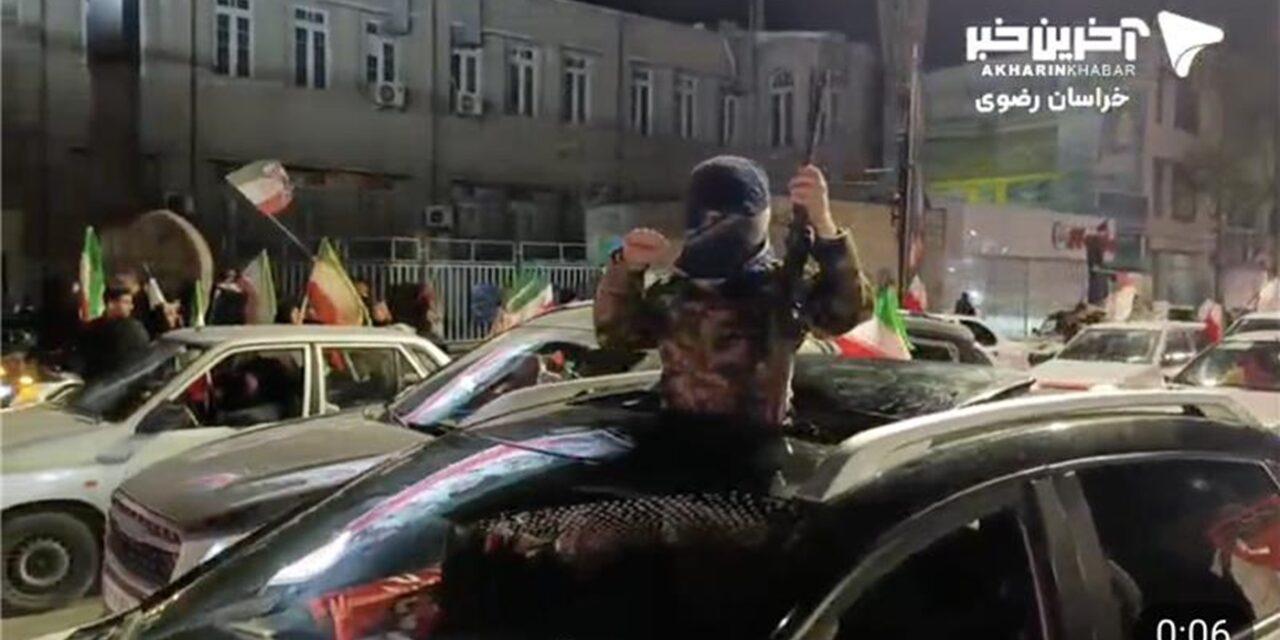
As Trump’s ultimatum neared, the IRGC urged parents to send their children onto bridges that were expected to be attacked.
Evidence is emerging of minors being used by the Iranian regime in security and military roles after the IRGC asked for volunteers as young as 12 years of age.
While global attention focuses on Washington’s rhetoric and military action, far less scrutiny is being given to what is happening inside Iran itself.
On the eve of President Trump’s strong ultimatum against the Iranian regime set for last Tuesday at 8pm Washington time, the Iranian regime turned to its secret weapon, typical of every other jihadist regime that is an enemy of Israel – its children.
Trump’s threatening wording against the world’s largest sponsor of terrorism that has vowed to destroy Israel and the West divided opinion among many. Some in the West felt his rhetoric to wipe out a ‘civilisation’ if Iran didn’t reopen the Strait of Hormuz went too far. “The entire country can be taken out in one night,” Mr Trump declared. Most, even if they did not agree with his choice of language, understood this to mean the regime.
But there was less condemnation of what was taking place in Iran itself, where pictures emerged of women and children being placed on key bridges, thought to be earmarked for attack.
Many news outlets, such as the BBC, reported that “some Iranians” were forming a human chain on bridges, such as Ahvaz’s White Bridge. While footage shows that this included adults, the tactics being deployed by the Islamic Revolutionary Guard Corps (IRGC) were going largely unreported.
Alireza Rahimi, identified by Iranian state television as the secretary of the Supreme Council of Youth and Adolescents, issued a video call, saying: “Power plants that are our national assets and capital, regardless of any taste or political viewpoint, belong to the future of Iran and to the Iranian youth.”
Later, a Revolutionary Guard general urged parents to send their children to man checkpoints, which have been repeatedly targeted in airstrikes.
The UN Secretary General condemned the US for threatening civilian infrastructure, but didn’t say a word for Iran threatening civilians.
The Iranian regime’s tactic shouldn’t come as a surprise. The regime has been recruiting children into its war effort, targeting teenagers, indoctrinating them, and placing them in operational roles. This isn’t mere speculation; it is documented. And it is a state-backed campaign, not isolated incidents.
Minors are being used at checkpoints, in patrols, and in support of military operations, putting children directly in harm’s way. Under international law, recruiting children under 15 into armed conflict is a war crime; likewise, using minors in military operations also violates basic human rights protections.
It comes amid reports that the IRGC has now launched a programme called “Defender of the Homeland,” inviting teenagers aged 12 and above to take part in what it describes as “defensive, rescue, and support activities.”
Rahim Nadali, an official with Tehran’s IRGC unit, said the programme would assign children to tasks including patrolling and manning checkpoints. Recruitment would take place in Basij-affiliated mosques and at city squares hosting pro-government rallies.
According to a report by an IDF spokesperson, “The regime in Iran is actively recruiting teenagers and children into its war effort through regime-linked forces, including the Basij militia.”
According to the report, the regime is targeting boys as young as their early teens, students and vulnerable youth, and children exposed to ideological messaging. It is prepared to exploit its own children, using ideology to justify risk and sacrifice, filling its ranks with minors as pressure increases.
Recruited minors are being deployed to staff checkpoints, patrol urban areas, and support military and security operations. The heartbreaking consequence of this is that children are not kept from danger; some reports indicate that minors have already been killed while serving in these roles.
The exploitation of children by the Iranian regime and IRGC is yet more proof that this is a regime prepared to use deeply disturbing methods to defend itself.
Maryam Dehkordi, a child rights activist, told The New Arab that the current mobilisation of children follows a pattern stretching back decades.
“Using children in Iran has a precedent going back to the early years after the 1979 revolution,” she said, “though back then it was not as organised or state-controlled as it is today.”
Dehkordi said the practice intensified whenever the government needed to project strength or fill workforce gaps.
“The main reason the Islamic Republic uses children today is as human shields,” she said. “Schools, parks, playgrounds, and public spaces that should be for normal civilian life have been converted into government vehicle parking lots, assembly points, or bases. The regime seeks to use civilian casualties to gain political and propaganda advantage.”
The Iranian regime does not care for civilian life. While Israel does its best to minimise and avoid civilian casualties, its enemies target Israeli civilians indiscriminately and use their own civilians as human shields.
More needs to be said in the West, including by UK and European leaders, condemning Iran’s brutality; and it might be worth remembering that in the fight between good and evil, there is a clear distinction between the two.