
One soldier’s wrongdoing should not be used to condemn an entire nation.
Israel’s swift condemnation and prosecution highlight accountability often absent elsewhere in the Middle East.
Some reactions, rooted in antisemitic tropes, sought to drive a wedge between Christians and Jews. But the grace-driven Christian response should be different.
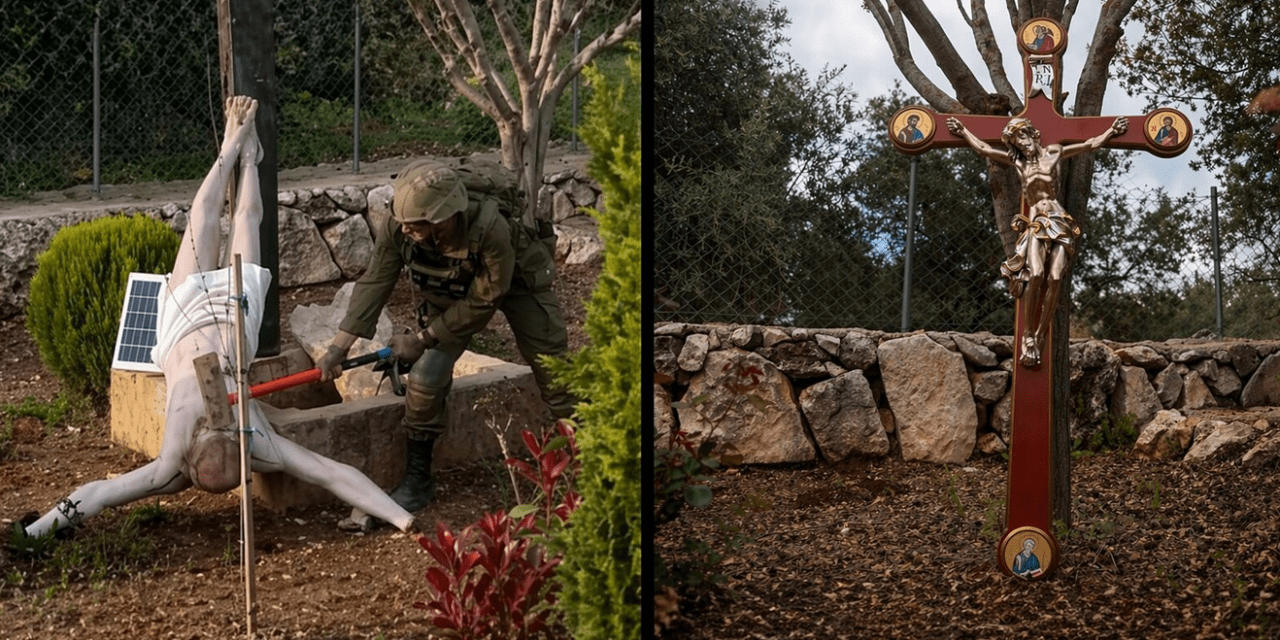
A photo of a crucifix statue being sledge-hammered by an IDF soldier in Lebanon has gone viral, prompting a strong global reaction. Many in the local Lebanese Christian community would rightly have been shocked, and perhaps even fearful, following the incident, which is why Israel was right to condemn it and take action against the soldier. But while some reactions in the West used antisemitic tropes to smear an entire nation and try to drive a wedge between Christians and Jews, followers of Jesus should take a different approach.
Christians throughout the Middle East are subject to persecution, largely by radical Muslims, and Lebanese Christians need our support. Yet, the destruction of crosses and attacks on Christians themselves rarely get reported in the West; unless, of course, it is perpetrated in this rare instance by an Israeli soldier.
After the photo went viral, some Christians in the West were quick to associate the actions of one individual with the entire State of Israel. This is wrong. Even if this soldier was not alone or not the first, it is extremely naïve to form a worldview on an entire nation based on the actions of an individual. It was alarming to see some online commentators, outraged yet revelling in the actions of this soldier, in order to validate their own anti-Israel views.
Christians are persecuted throughout the world – not just the vandalism of Christian symbolism – but worse. However, unlike how many other countries in the region that would remain silent, the State of Israel came out strongly in condemnation.
The IDF has been quick to act, removing from combat duty both the soldier who damaged the statue and the one who filmed the act, sentencing them both to 30 days in military prison. Unlike other governments in the region, Israel holds their personnel accountable to the law.
Israel has also replaced the damaged crucifix statue. The IDF said troops worked with the community in the Lebanese village of Debel to coordinate the replacement.
The IDF statement reads, “The IDF views the incident with great severity and emphasizes that the soldier’s conduct is wholly inconsistent with values expected of its troops.”
Meanwhile, Israel’s Prime Minister, Benjamin Netanyahu said, “Yesterday, like the overwhelming majority of Israelis, I was stunned and saddened to learn that an IDF soldier damaged a Catholic religious icon in southern Lebanon,” and Israel’s Foreign Minister Gideon Sa’ar described the attack as “grave and disgraceful.”
Israel’s condemnation is reflective of its treatment of Christians. It is a country where the Church is able to meet and worship in freedom. That said, how should we as Christians respond when we witness such an attack directed at Christianity? Does it fill us with anger? Do we feel vengeful? Or should we respond differently?
While seeing a representation of Jesus treated with such barbarity is saddening, it is nothing new. Jesus Himself said that believers in Him should expect hatred. Matthew 10:22, Jesus said, “And you will be hated by all for My name’s sake.” John 15:20 states, “If they persecuted Me, they will also persecute you.” Jesus knew that many would find the Cross offensive and Christians would be targeted for His name’s sake, yet the Cross was the place He gave Himself in love and grace for the world. Without downplaying the crime by the IDF soldier, it would be better to pray for him.
Unfortunately, some commentators online compared the perpetrator’s actions with the age-old trope accusing Jews of killing Christ and holding every Jew in Israel and around the world guilty. This is antisemitic.
Romans 11 says that the children of Israel, having rejected Jesus, are “enemies of the gospel.” It is important to emphasise “the gospel”, which simply acknowledges that not all Jews agree with Gentile Christians on recognising Jesus as Messiah. The term “enemies” is perhaps better understood as meaning in opposition to. It does not mean being an enemy in any other context. However, Romans 11 explains that this is for the benefit of the Gentiles, and in turn Gentiles should have gratitude and compassion towards the Jewish people. Romans 11 even describes Israel as being “beloved”, which has the root word ‘agape’, reminding the reader that God’s love for His people is everlasting.
Romans 11:28-31: “Concerning the gospel they are enemies for your sake, but concerning the election they are beloved for the sake of the fathers. For the gifts and the calling of God are irrevocable. For as you were once disobedient to God, yet have now obtained mercy through their disobedience, even so these also have now been disobedient, that through the mercy shown you they also may obtain mercy.”
The condemnation by Israel in response to this vandalism is appreciated. But the attack has exposed attitudes of some Christians towards Jews, spurred by replacement theology and influenced by a wave of anti-Jewish sentiment in some sections of society that the Church itself, not Israel, needs to address.