
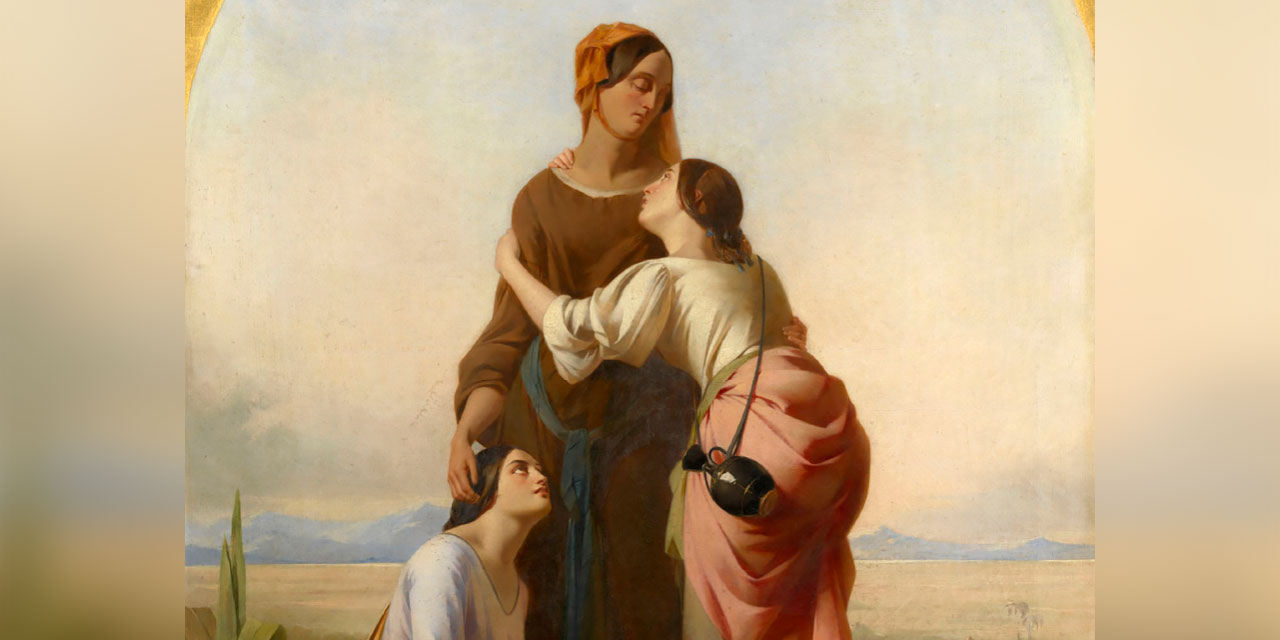
“Wherever you go, I will go,” the Gentile widow promised her Jewish mother-in-law. “Your people shall be my people, and your God, my God.”
These were remarkable words of loyalty from Ruth to Naomi that marked a turning point in the Gentile-Jew relationship and foreshadowed God’s destiny for the Gentiles. Yes, it is God’s will for the Gentile people to worship the One True God, the God of Abraham, Isaac and Jacob, the God of Israel. Ruth’s sister-in-law Orpah chose to leave Naomi and return to her people and worship their false gods. With great weeping, Ruth defied Naomi’s command to leave and instead “clung to her”. Her journey to the harvest fields of Bethlehem into marriage with Boaz would lead this faithful Gentile woman to become the great-grandmother of King David, and part of Jesus’s ancestry.
This picture is important to understand when reflecting on the impact of Replacement Theology. God’s design is for Gentiles to be brought into the Abrahamic Covenant. We see a final fulfilment of this prophetically in Isaiah 56:7. It speaks of a Messianic Age when God’s Temple will become a “house of prayer for all nations”. Certainly, there will be no room for antisemitism then!
Scripture explains that Gentiles are brought into the Abrahamic Covenant through faith in Jesus Christ; but God’s promises to Israel have not been replaced. As we observed previously in Part 4 of this series, Romans 11 clearly lays out the dynamic of the new relationship between Jews and Gentiles, and Israel and the Church. Replacement Theology is damaging to the Jew-Gentile relationship because it misrepresents the position of Israel. It digs up and throws out the Jewish root of the Christian faith, it denies the everlasting nature of the promise made to the Jewish people, and it delegitimises the Land itself as part of God’s Covenant. Consequently, the spirit behind Replacement Theology has contributed to very “un-Christian” attitudes towards Jews for over 2,000 years.
Satan’s tactics against the Covenant
The wedge between Christians and Jews is Satan’s attempt to destroy God’s beautiful picture of a thriving Olive Tree as depicted in Romans 11. Satan is an enemy of the Abrahamic Covenant, because he is against God Himself. His intent is to wipe Israel off the face of the earth so that it can be remembered as a nation no more (Psalm 83:4). He is also an enemy of the Gospel, because he does not want Gentiles to be grafted into the Olive Tree, and he is also against the “wild olive branches” (Israel) from being grafted in again. Satan exploits wrong attitudes towards Jews to drive a wedge between Christians and Jews, because it dishonours the Olive Tree.
Christians must not fall for Satan’s tactics. A proper interpretation of Romans 11 should lead the Christian to understand that believing Gentiles have been “grafted in”; that we must avoid boasting against the root; that Gentiles were once disobedient just as Israel had been, yet have received mercy; that opposition to the Gospel might exist; nevertheless “the gifts and calling of God [to the Jewish people] are irrevocable”.
Mistreatment of Jews is a heart matter
The wedge between Christians and Jews is as much a heart issue as it is a theological one. In Matthew 25, Jesus referred to His own brethren (the Jewish people) when describing how nations will be gathered together and separated one from another, like a shepherd divides his sheep and goats. This separation is dependent on their treatment of the Jewish people, and God equates their treatment of Israel to their treatment of Him. Matthew 25:40 says, “‘Assuredly, I say to you, inasmuch as you did it to one of the least of these My brethren, you did it to Me.’” This verse alone should cause every Christian, who seeks to follow Jesus, to question how they treat the Jewish people, both in their heart and practically.
The mistreatment of Jews by Christians is disastrous, not only because of the consequences suffered by Jews, but because Christians are falling short of their God-given mandate to bless the Jewish people. If turning against Jews displeases Jesus Himself, then sadly they are not enjoying the blessing found in the grafted branch and are placing a hindrance in their own spiritual walk.
Replacement Theology deprives Christians of revelation
Many proponents of Replacement Theology are not necessarily “against Jews”, but it cheats Christians of fully embracing the depth of riches discovered in the Hebraic roots of our faith, introducing a stronghold that prevents revelation regarding Israel and the Jewish people. In its worst application, Christians who embrace Replacement Theology are being short-changed in their complete understanding of the Gospel and are prone to related false teachings, conspiracies, and hard-heartedness towards Jews. Ultimately, Replacement Theology feeds antisemitism and the practise of it demands repentance.
Examples of ‘weaponised’ phrases
Christians mistreating Jews hasn’t only affected Jews and Christians separately, but it often creates a wedge between the two. It is understandable that there has been a mistrust felt by many Jews towards Christians because of the way that some Christians have behaved. Let us look at some of the ways that these wedges have been formed:
“The Jews killed Jesus”
Part 1 of this series addressed this topic comprehensively. However, it is important to recognise that this statement has been used against the Jews for two millennia. Sadly, it is no longer confined to the ignorance of the Middle Ages; even in this social media age it is a common slur used against the Jews.
The accusation can be countered evidentially, theologically and rationally.
Evidentially-speaking, the Bible, supported by historical understandings of Roman crucifixion, lays out in detail the involvement of Roman and Jewish authorities, and how both interacted in Jesus’s crucifixion – quite removed from blaming your local Jewish community, a Jew on Facebook, or the IDF for killing Jesus!
Theologically-speaking, as Christians we recognise the prophesied significance of Jesus’s rejection by many of His own brethren but view it as a fulfilment of God’s plan. We witness Jesus’s words “forgive them, for they know not what they do”, and we recognise the purpose of Jesus’s death as being an atoning sacrifice, when He said, “No one takes it from Me, but I lay it down of Myself. I have power to lay it down, and I have power to take it again. This command I have received from My Father” (John 10:18).
Rationally, if Jesus didn’t die on the cross, then our sins would not have been forgiven, and Gentiles would not be grafted in. Also, Jesus himself was Jewish as were the multitudes of His followers. Jesus’s sacrifice is good news to those who believe; there is no need to be resentful of Jews. Furthermore, Christians believe that Jesus is not dead, He is alive! Anyone blaming Jews for Jesus’s death is in ignorance of the Gospel message. If you ever hear a Christian say the Jews killed Jesus, just ask them if they believe Jesus is still dead.
“The Synagogue of Satan”
The phrase ‘Synagogue of Satan’ appears twice in the book of Revelation and has been widely misused by antisemites to demonise Israel and Jewish people worldwide. This is completely unscriptural.
Revelation 2:9 and Revelation 3:9 address the persecuted churches in Smyrna and Philadelphia. These two churches were under immense persecution and were about to suffer greatly. To the angel of the church in Smyrna it is written, “I know your works, tribulation, and poverty (but you are rich); and I know the blasphemy of those who say they are Jews and are not, but are a synagogue of Satan. Do not fear any of those things which you are about to suffer. Indeed, the devil is about to throw some of you into prison, that you may be tested, and you will have tribulation ten days. Be faithful until death, and I will give you the crown of life” (Revelation 2:9-10). In a book that is strong in its rebuke towards the other five unfaithful and compromising Churches, the jaw-dropping term ‘synagogue of Satan’ is not out of place. But it does not describe Jews today and it didn’t even describe Jews then.
The word ‘synagogue’ means ‘gathering’ or ‘assembly’. It is not referring to your local synagogue or the Israeli government! It specifically referred to a local group that was persecuting the Church and who claimed to be Jews. Revelation 2:9 uses the word “blasphemy”: “I know the blasphemy of those who say they are Jews and are not, but are a synagogue of Satan.” They were not being “blasphemous” for claiming to be part of the Church. They were not being “blasphemous” for refusing to be part of the Church. Nor does it have anything to do with “not all Israel is Israel”, which some replacement theologians try to associate it with. They were being “blasphemous” for claiming to be Jews, but not acting like Jews. Nowhere else in the New Testament do we see Jews being rebuked simply for being Jews. In fact, the Churches themselves were largely made up of both Gentiles and Jews. They were being held to account for their actions, and rightly so, but they were not being held to account for being Jewish.
How the wedge was driven
Antisemitism didn’t begin within the past 2,000 years. Jew-hatred has existed before the Romans, before Haman and before Pharaoh – ever since God set apart His Chosen people and made a Covenant with them, Satan has tried to undermine it. In fact, one should conclude from Satan’s rebellious character, that he has been antisemitic from the dawn of time.
We will now look at how the wedge has been driven since the foundation of the Church. At the turn of the first century, the first believers in Jesus Christ were recognised as simply another Jewish sect. The disciples were Jewish and the early Church was by nature largely Jewish (to the Jew first). In response to the Great Commission given by Jesus to go out to all nations with the Gospel, the body of Christ multiplied and began to include non-Jews (Gentiles).
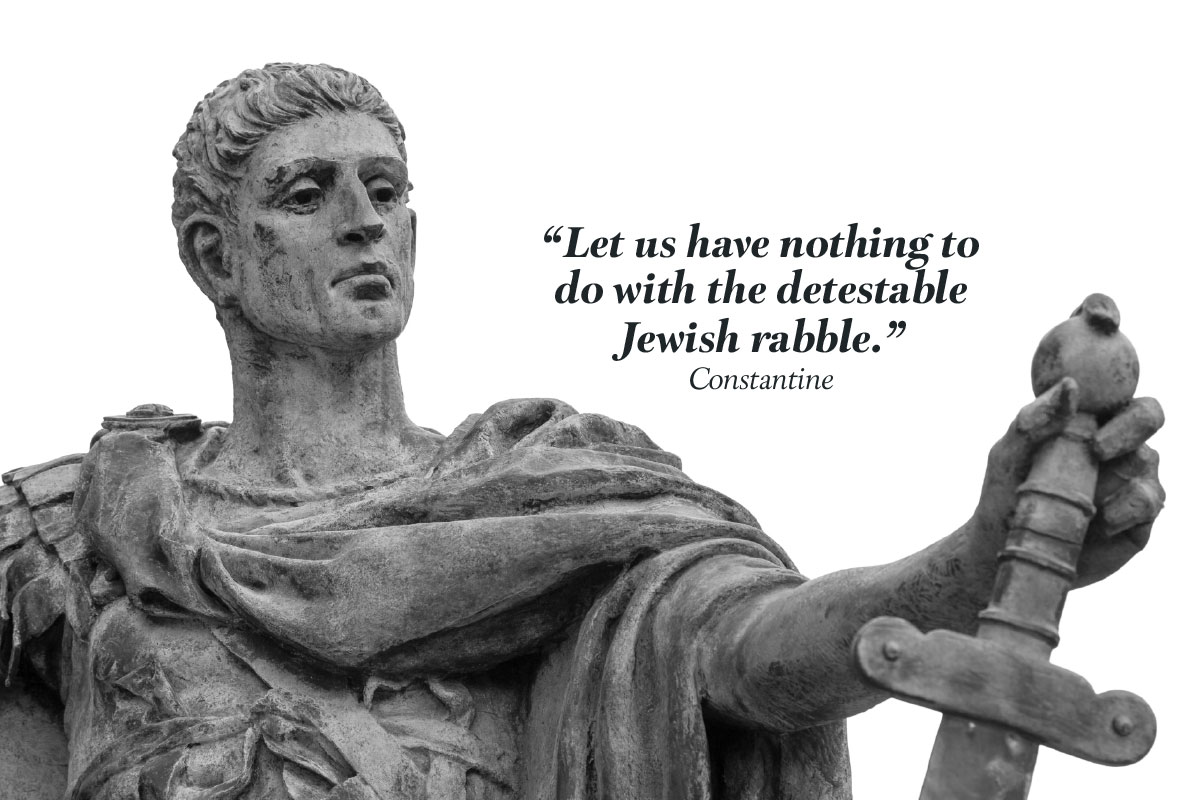
When Roman Emperor Constantine converted to Christianity and favoured Christianity within the Roman Empire, he did so with a blend of paganism and Hellenism. The Empire officially became Christian under Emperor Theodosius I in 380 AD. To resolve doctrinal controversies facing the newly formed Roman Church, Constantine held the Council of Nicaea in 325 AD. This first empire-wide council of church leaders led to the adoption of the Nicene Creed and resulted in the separation of Christianity from Judaism.
In Constantine’s own words, the objective was clearly to disconnect the Church from its Jewish roots: “Let us have nothing to do with the detestable Jewish rabble.” Christians were prohibited from following the Torah and observing the Sabbath and the Jewish feasts. Passover was increasingly separated from its Jewish context and replaced in the Roman Church calendar by Easter observances.
Observant Jews continued to adhere to the Torah and the Jewish feasts, and they refused to participate in pagan practices. Many Jews who refused to accept Jesus as Lord were viewed as deliberately defying Rome’s rulers and the Empire’s official ‘Christian’ religion, which embraced idols, pagan worship, and even polytheism.
Judaism and Christianity are both rooted in the Old Testament, but many church fathers affirmed that Christian doctrine superseded Judaism. This false teaching of anti-Jewish Supersessionism brewed a hatred towards Jews within the Roman Church and was the precursor to modern Replacement Theology. It was a deliberate attempt to discourage Christians from observing Jewish feasts and customs. For the first 400 years, many church fathers issued anti-Jewish rants. Among them, Augustine wrote harshly about Jews in several works, contributing to anti-Jewish attitudes within Christendom.
It is sadly not surprising that over the next centuries societal attitudes towards Jews were formed. Jews were demonised, scapegoated, viewed with suspicion, and ostracised.
By the 4th century, Jews in Italy were confronted with forced conversion. Jews in Carthage (modern-day Tunisia) were expelled and whole communities in Europe were destroyed. Jews were banned from Jerusalem and the entirety of the Roman Empire.
Between the 5th and 8th centuries, Jews were prohibited from holding important financial positions, including judicial and executive officer. Jews were forbidden from even reciting Psalms whilst burying their dead..
Throughout Europe, Jews were not allowed to join trade guilds. Jewish people were excluded from owning land, holding office, and from becoming doctors and lawyers. At the Third Lateran Council of 1179, Jews were forbidden from testifying against a Christian in court and were prohibited from withholding an inheritance from descendants who had converted to Christianity.
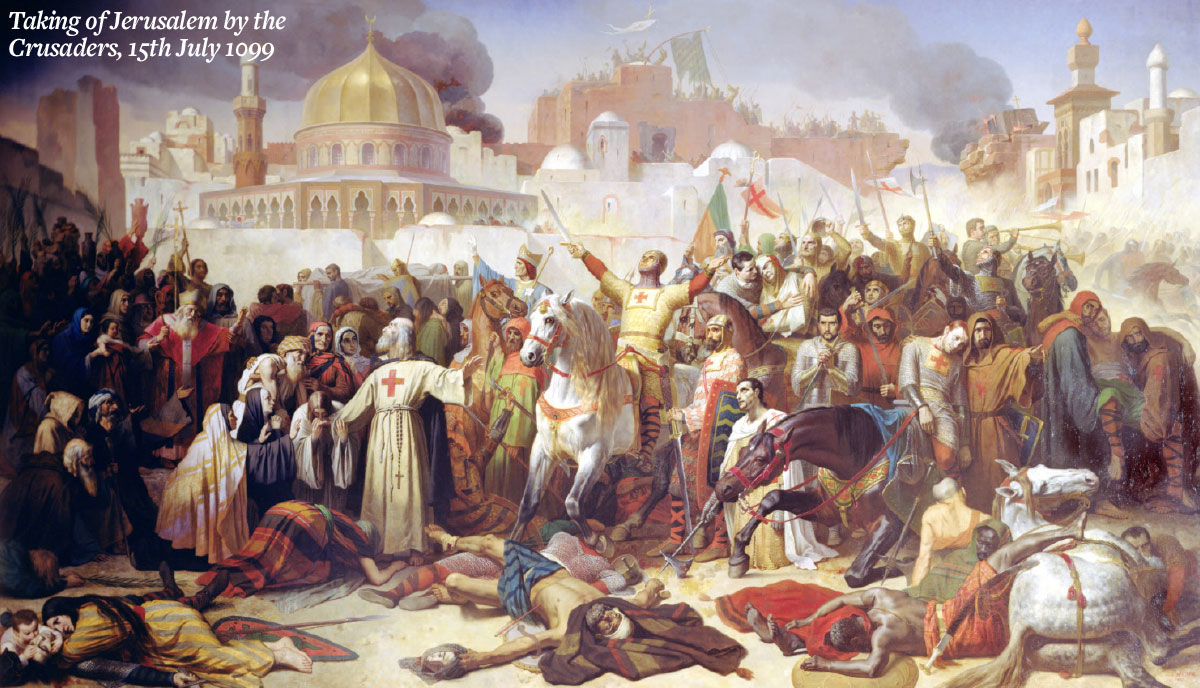
The Crusades were calls to action for Christians to liberate the Holy Land from the Muslims. However, during the First Crusade in 1095, it was decided to attack Jewish communities also along the way to Jerusalem using the slogan: “Why fight Christ’s enemies abroad when they are living among us”. As a consequence of Rome’s campaign, vigilantes marched under the sign of the cross sweeping through Jewish communities, looting, raping and massacring thousands of Jews on the road to Jerusalem. In Germany, 5,000 Jews were murdered in various cities. In 1124, the whole Jewish Quarter of Kiev was destroyed. Large numbers of Jews were massacred in Morocco.
Evil lies about Jews continued to spread throughout Medieval Europe. Jews were blamed for virtually everything. Jews were blamed for the Bubonic Plague in the Dark Ages, which killed an estimated one-third of Europe’s population. The Jews were accused of poisoning wells leading to the spread of the Black Death. Based on this lie, thousands of Jews were massacred throughout German-speaking Europe.
On Passover 1144, a Christian boy disappeared in Norwich, England. Immediately, locals accused the Jews of murdering the boy in order to use his blood for ritual practices such as the making of matzo at Passover, a blood libel that continues to be told about Jews today. In 1171, Jews in Blois, France, were falsely accused of murdering a Christian child, leading to the execution of more than thirty Jews. In 1189, anti-Jewish violence erupted in London during the coronation of Richard I after rumours spread that Jews had insulted Christianity. In 1190, many Jews in York were massacred after taking refuge in Clifford’s Tower to escape a violent mob driven by debt, religious hatred, and false accusations. In 1255, after the death of a Christian boy named Hugh in Lincoln, Jews were falsely accused of ritual murder in what became known as the “Blood Libel of Lincoln.”
England was the first kingdom in medieval Europe to expel its Jewish population nationally in 1290. Medieval Christian hostility toward Jews had grown for centuries, fuelled by anti-Jewish religious teachings, blood libel accusations, and resentment toward Jewish moneylenders. Because many Christians were restricted by Church law from lending money at interest, Jewish moneylending became economically useful to the Crown and to landowners. The Crown heavily taxed Jewish communities and treated them as royal property, leaving them politically vulnerable despite the protection they received under royal authority. Jewish communities nevertheless made important contributions to England’s economy through finance and trade. Over time, however, the Crown failed to protect England’s Jews from growing hostility. Faced with financial pressures from warfare and political demands, King Edward I confiscated their assets and expelled the Jews from England in 1290, only for Jews to return under Oliver Cromwell’s rule almost 400 years later.
By the thirteenth century, some European authorities had begun restricting where Jews could live, often concentrating Jewish communities into designated quarters. In later centuries, compulsory segregated districts became known as “ghettos”, with Jews in some cities forced to live in specific areas after being removed from their homes.
One of the earliest medieval pogroms in Germany occurred in 1241. After a debate about interfaith marriages, 180 Jews were killed and 24 were forced to convert. In 1389, 1,500 Jews were massacred in Prague on Easter Sunday. By the 1800s, pogroms took hold throughout Russia and anti-Jewish riots were commonplace throughout Europe.
Meanwhile, in fifteenth-century Spain, the Crown increasingly demanded religious conformity from Jewish converts to Christianity, known as conversos, and prohibited them from continuing Jewish practices such as observing the Sabbath or celebrating Passover. Practising Jews were accused of influencing converts to return secretly to Judaism, increasing suspicion and hostility toward both Jews and conversos. Eventually, the Spanish monarchy introduced a policy of forced conversion or expulsion, culminating in the Alhambra Decree of 1492, part of the Spanish Inquisition.
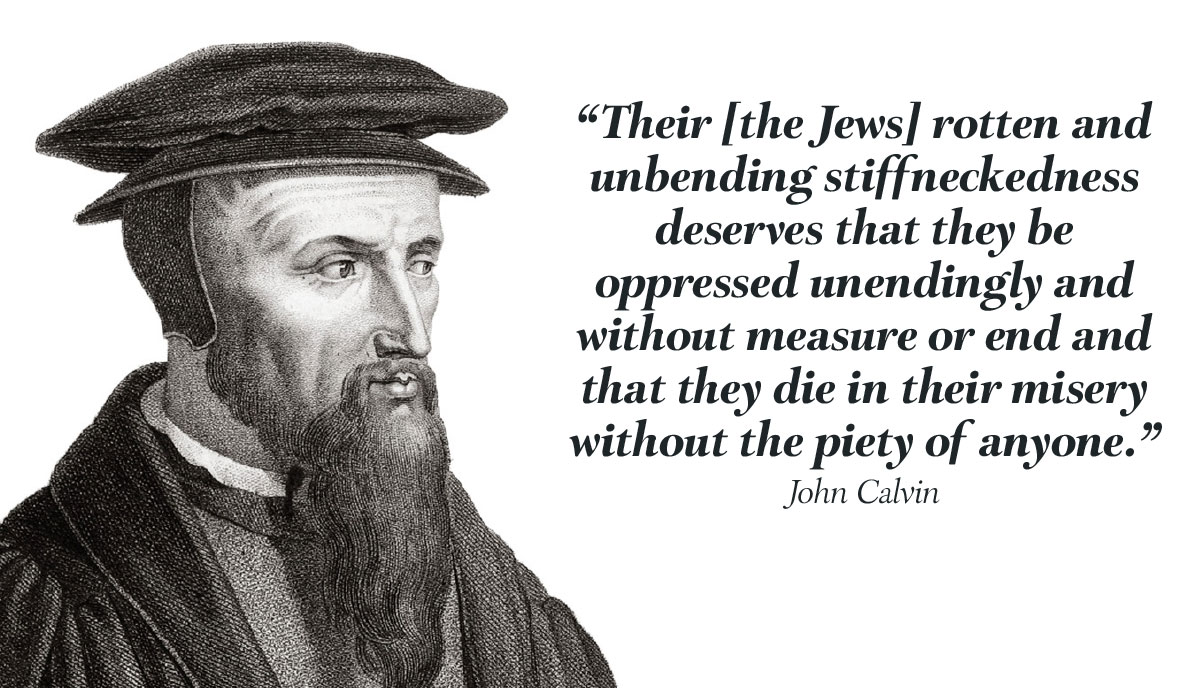
Despite the wonderful outcomes of the Reformation, the relationship between Jews and Christians was not necessarily eased. A leading Reformer, John Calvin, stated that “their [the Jews] rotten and unbending stiffneckedness deserves that they be oppressed unendingly and without measure or end and that they die in their misery without the piety of anyone.”
Another key Reformer, Martin Luther stated in his leaflet “The Jews and Their Lies” (1545) that the Jews should have their tongues cut out through the back of their heads, their synagogues burned to the ground, and their children sold into slavery. Four centuries later, in 1935, the Nazis would reprint Luther’s inflammatory leaflet to be used eventually by propagandists in support of Hitler’s Final Solution. Where was the Church in the darkest chapter of Jewish history, when six million Jews were murdered? Like the division of sheep and goats, many Christians thankfully rose up and stood by the Jewish people; many Christians, however, were too indoctrinated by anti-Jewish sentiment to speak up.
In 1905, the fictitious publication “The Protocols of the Elders of Zion” was published in Russia and promoted the myth that Jews had devised a “secret plan to rule the world by manipulating the economy, controlling the media, and sponsoring various religious conflicts.” Chillingly, we see the same rhetoric peddled by some social media commentators and influencers today, whose lies are responsible for driving another wedge between Christians and Jews. They claim to be speaking as Christians but are ignorant of Bible Truth.
The shameful events stated in this article, and many more, could have been avoided – or at least stamped out sooner – if the Church had not deviated from its Hebraic roots and falsely “replaced” Israel in its doctrine. These examples of antisemitism within Christendom feel far removed from the Biblical Christianity that we recognise as true followers of Jesus. This is the fruit of Replacement Theology – it isn’t simply a theology, it is a spiritual stronghold against the truth, and its fruit dishonours God.
It is understandable why historic antisemitism from those within Christendom has caused a wedge between Christians and Jews. As Christians, we reject every false doctrine that has tried to separate Christianity from the Bible’s Jewish roots, and every stronghold that has sought to destroy the relationship between Christians and Jews. The time has come to take the ground back. The relationship between Christians and Jews is being healed, and as a Christian, you are part of the restoration that God is bringing in this generation, in this day.
Thankfully, despite the Church’s role in fuelling antisemitism, there have been many Christians over 2,000 years who have faithfully taught the Biblical view on Israel and God’s plan and purpose for the Jewish people. In the next part of this Debunking Replacement Theology series, we will look at the antidote to the wedge that has been driven between Christians and Jews. It is a message of hope that has the power to quell every antisemitic attitude that exists today within the Church.
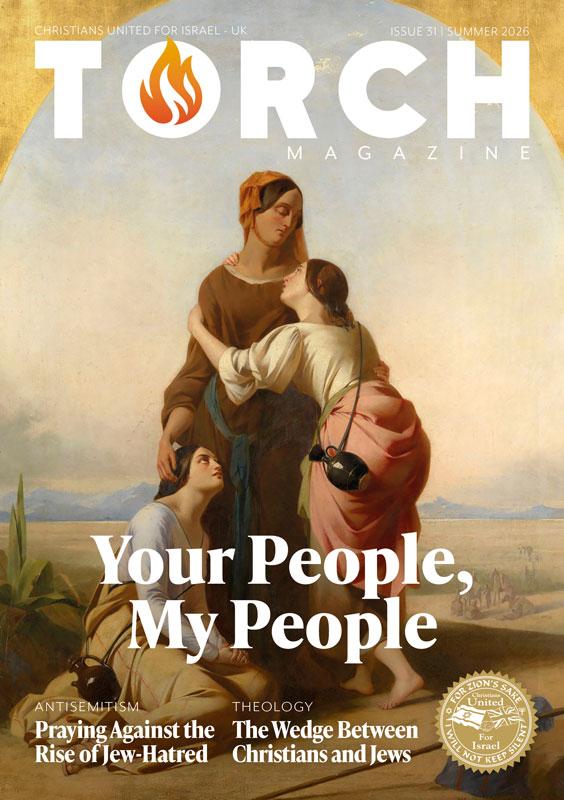
This article first appeared in the CUFI UK Torch Magazine (Issue 31, Summer 2026).
To receive future issues and access to all past issues of the Torch Magazine, please subscribe for free at www.cufi.org.uk/subscribe