
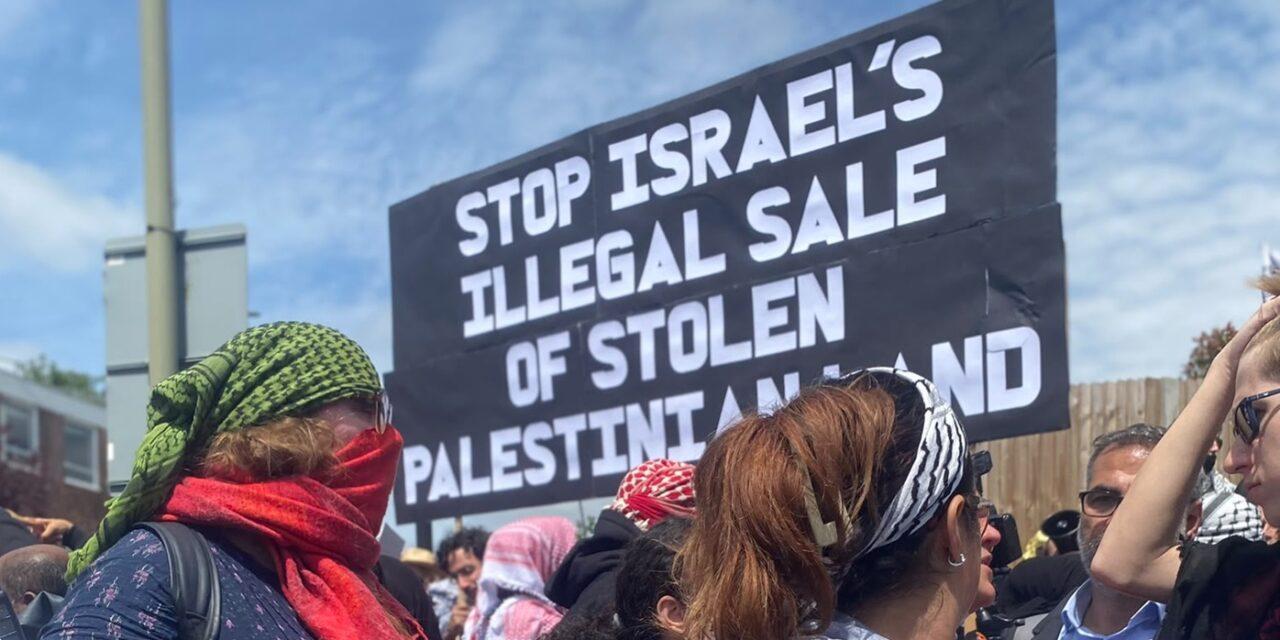
- Hundreds of pro-Palestinian protesters gathered outside a London synagogue, using an event advertising property in Israel to target a Jewish place of worship with anti-Israel slurs.
- The Mayor of London called for the event to be cancelled and the UK government has actioned an investigation into the event, not the protest.
- Claims of “stolen land” are not careful legal arguments about individual properties, but part of a wider campaign that denies Israel’s legitimacy altogether.
- There is absolutely no justification in bringing a territorial dispute to the doors of a Jewish synagogue in London.
- Guess who holds the title deeds?
Hundreds of pro-Palestinian protesters that gathered outside Edgeware United Synagogue in London last weekend were not there to make a legal submission about a land dispute. They were using the occasion to target a Jewish place of worship with unfounded anti-Israel slurs.
The synagogue was holding a special real-estate event about property in Israel after the original venue withdrew just days before. Synagogues are not only places of worship, but are central community hubs, much like church halls are to church buildings; many British Jews also have personal connections to Israel, and either way, why shouldn’t they be allowed to hold such an event? The Land of Israel is integral to Jewish identity.
But the pro-Palestinian protest was defined by ugly intimidation outside with chants accusing Jews of selling “stolen land”. The controversy was made more complicated when it was reported that brochures and marketing materials at the event included properties beyond the Green Line in Judea and Samaria (the so-called West Bank), in areas the UK Government regards as “occupied territory”. This appeared to contradict earlier assurances by organisers that properties over the Green Line would not be promoted. Organisers later apologised for the inclusion of West Bank properties in event literature, while insisting they were not promoted or sold. The complaints against the event gained widespread media attention, with the Mayor of London and a hundred Parliamentarians reportedly condemning the event and calling for it to be cancelled. Furthermore, the UK government has asked the Advertising Standards Agency (ASA) to investigate the allegations.
But let’s take a few steps back.
Firstly, those protesting were not making a judicial claim about what is legal and what is not. When anti-Israel activists chant “stolen land” they are not making a careful legal point about planning permission; they usually mean the whole Jewish state. The focus specifically on the “Green Line” in Judea and Samaria is irrelevant to them. Those pretending otherwise give protesters far too much credibility. There is nothing critical about their arguments – when they say “stolen land” they mean Israel in its entirety.
Secondly, there are dozens of unresolved territorial disputes around the world. There are at least 40 disputes between countries or territories, yet only Jewish homes in Judea and Samaria are routinely singled out as illegitimate. Imagine hundreds of protestors gathering outside Pakistani-linked mosques intimidating worshippers over the Kashmir dispute, or outside Turkish businesses, over disputed land in Cyprus. Jews are targeted not because of a complex land dispute, but because of Israel’s existence.
Thirdly, there is a serious legal argument that the properties in question – and only a few were highlighted as contentious – are not automatically illegal. The West Bank has never been the sovereign territory of a Palestinian state. It was controlled by Jordan after the 1948 Arab-Israeli war, but Jordan’s annexation was recognised by only a small number of states. Its final status was left unresolved, and later agreements, including the Oslo Accords, treated the territory as subject to negotiation rather than as settled Palestinian sovereign land.
In other words, to declare every Jewish home beyond the 1949 armistice line “illegal” is to prejudge a territorial dispute that international agreements themselves left for negotiation.
The usual argument against Israel relies on Article 49(6) of the Fourth Geneva Convention, which prohibits an occupying power from deporting or transferring parts of its own civilian population into occupied territory (ICRC, 1949). But Israel’s legal case is that this provision was drafted after the horrors of the Second World War to stop forced population transfers of the kind carried out by Nazi Germany. It was not intended to criminalise Jews voluntarily buying, building or living in homes in areas where the Jewish people have deep historic, legal and ancestral ties.
This is important to emphasise. No one is being marched into Judea and Samaria at gunpoint. No one is being deported there by the Israeli state. Voluntary residence by Jews in any territory – even if disputed internationally – is not automatically unlawful.
Nor does the mere advertising of property prove illegality. Even taking the UK Government’s own position that is hostile to Jewish “settlements”, it does not mean that every advertised plot of land is a criminal act. There is a difference between political opposition and a court finding that a particular property transaction is unlawful.
If critics claim that a particular property is unlawful, they should identify the land, the ownership, the planning status and the exact legal rule that has been breached. What they should not do is point to the presence of Jews beyond the Green Line and declare that the property is illegal by assertion.
The Green Line itself was never an internationally recognised border. It was an armistice line from 1949. The idea that Jewish homes on one side of that line are legitimate while Jewish homes a few miles away are inherently criminal is therefore a political position, not an inevitable legal conclusion.
The UK Government says that Israeli settlements are illegal under international law. UN Security Council Resolution 2334 states that settlements in territory occupied since 1967 have “no legal validity”. But these do not erase Israel’s legal argument. They do not prove that every individual property advertised is criminal or incapable of lawful private ownership.
The stronger and more accurate position politically is this: Israeli settlements in Judea and Samaria (the West Bank) are disputed, their final status is unresolved, and Israel has substantial legal, historical and security claims.
That said, asserting that any part of Israel is stolen land, is nothing more than an antisemitically fuelled lie.
And there is absolutely no justification in bringing a territorial dispute to the doors of a Jewish synagogue in London. Since when did it become acceptable to bully Jews outside a synagogue in Britain?
It is important to also remember that the Land of Israel is the ancestral homeland of the Jewish people, granted by God, who owns the Land and gave it to His people in an everlasting Covenant.
He holds the title deeds.